
Speaking With One Voice Across 100 Agencies: A Multisite Platform for the State of Rhode Island
Rhode Island’s 100+ government agencies were running on a fractured network of outdated websites. The state needed one Voice of Truth — and the operational capacity to speak it from every agency at once.

The work
“What stood out the most to me was the great synergy that our team developed. All team members were committed to a common goal to create an exceptional, citizen-centered resource that would go above and beyond the technical and design expectations of both agencies and residents alike.”
The Challenge: 100+ Agencies and No Single Voice of Truth
The State of Rhode Island runs more than 100 government agencies, each with its own constituents, communications needs and subject-matter authority. The digital surface a state speaks through is not a website; it is the backbone of public service — whether guidance reaches a constituent in time, whether a benefits application is reachable on a phone, whether a household that does not read English can get translated material. Rhode Island’s had grown one agency at a time, on platforms that no longer matched each other, and citizens getting different answers from different state sites had learned to trust none of them.
The Strategy: A Multisite Platform and a Unified State Government Design System
Make one voice operationally possible, and make it worth believing.
- Provisioning measured in minutes, on Drupal and Acquia Site Factory, so a new agency site arrives while the need for it is still live.
- Syndication as architecture, hub-and-spoke and asynchronous, so one message reaches many agencies without dozens of teams coordinating it by hand.
- A design system, not a template. The state government design system puts WCAG AA into the components themselves, which is the difference between accessibility being a property of the platform and being someone’s final check.
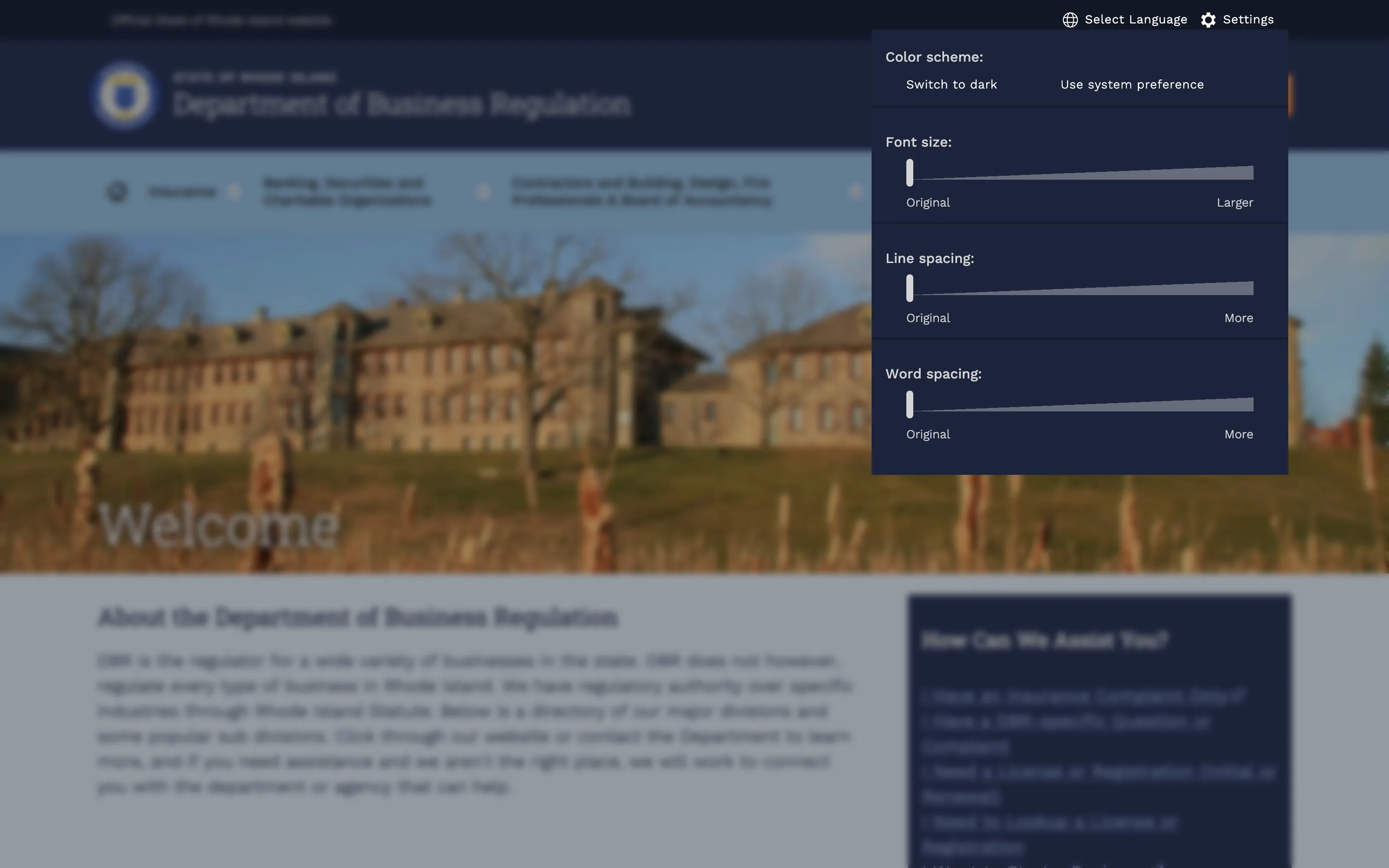
- Let the citizen set the terms — color scheme, type size, spacing and language — because a government that decides how you must read it is making a claim about who the page is for.
The Outcomes: 25 Agency Sites in the First Year, 350% Faster
The first sites on the platform went live four and a half months after the first line of code — 15 new sites inside eight months, 25 within the first year, each running three to four times faster than the site it replaced. A hundred publishers, one government, and a surface that says the same thing everywhere.
- Engagement | First launches 4.5 months from the first line of code; 25 sites in year one | Agency sites provisioned in minutes, with cross-agency syndication saying one thing everywhere
- Trust | WCAG AA throughout with many components at AAA, and Lighthouse accessibility consistently above 95% | Reading preferences under the visitor’s control, still shipping four years on | An Acquia Engage Award, Doers — Leader of the Pack, Public Sector, 2022
The detail
Why it mattered
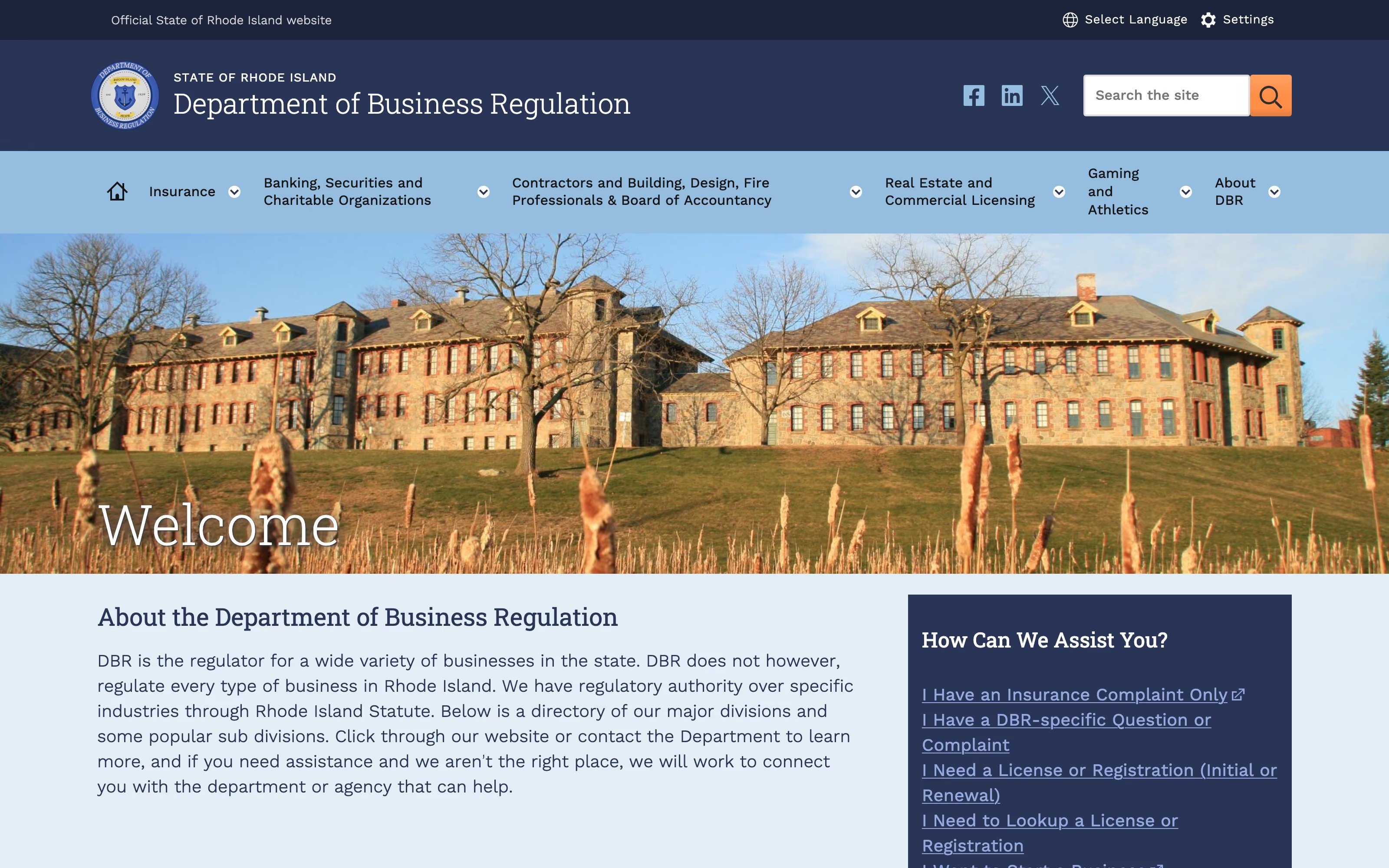
- Built site by site, over a long enough timeline that nothing unified it. The state’s digital infrastructure had grown the way most large government technology does — one agency, one platform, one design language at a time. Some sites ran on CMS platforms that had not been updated in years. Visual identity varied enough that the state looked like dozens of disconnected entities rather than one government.
- Publishing speed was capped by the slowest technical bottleneck. Content changes required engineering involvement at most agencies. When guidance changes by the day, a surface that takes days to update cannot keep up.
- Coordinated communication was not structurally possible. An update from the Department of Health needed to reach Education, Labor, Business Regulation and a dozen others at once, in consistent language. Nothing in the architecture supported that kind of push, so it fell to manual coordination across dozens of editorial teams.
- Accessibility was uneven, exactly where it mattered most. Citizens with disabilities, on slow connections, on phones or not reading English natively were the ones being underserved — the populations that most need a government site to work are the ones a fragmented network of sites serves worst.
- A new site could not be stood up at the speed of the need. A benefits program, a public information campaign, an emergency response — each wanted a site, and the provisioning pathway was too slow to deliver one while it still mattered.
- Accessibility is a legal requirement, not a preference. The ADA’s Title II rule holds state and local government web content to WCAG 2.1 AA, on federal compliance deadlines. Rhode Island built component-level conformance into its platform before the mandate arrived — the position every state now has to reach one way or another.
- And the fragmentation had itself become a Trust problem. Citizens who got different answers from different state websites learned to trust none of them. At that point the architecture is not an IT concern; it is the state’s credibility.
The call and the build
- Two faces, designed to reinforce each other. An operational face in every architectural decision and a Trust face in every design and content one. Neither works alone: a state that can publish everywhere instantly but inconsistently has multiplied the problem, and a beautiful site no one can update in time is not serving anyone.
- New agency sites provisioned in minutes. Built on Drupal and Acquia Site Factory with custom tooling on top. Batch commands stand up the site, register it with the state’s syndication services and put authors in front of the editor. The bottleneck that had capped the state’s digital response was removed rather than widened.
- Hub-and-spoke syndication, running asynchronously. Content published from a parent site — the Department of Health, say — pushes to designated child sites automatically and consistently. Saying one thing across many agencies became an operation the architecture performs instead of a coordination problem people solve by hand.
- A migration helper that reads the old site. Custom tooling scrapes existing properties and pulls their content forward — the step that made migrating a portfolio of 100+ agencies tractable at all. Unglamorous, and the reason the rest of it was reachable.
- A design system rather than a template. Component-based and built specifically for ri.gov properties. Every component meets WCAG AA and many meet AAA — color contrast, keyboard navigation, semantic labeling, ARIA handling and alt text enforcement built in at the component level, so accessibility is a property of the system rather than an audit at the end. Lighthouse accessibility scores landed consistently above 95%.
- The reading experience belongs to the citizen. Visitors can switch between light and dark, adjust font size, line height and word spacing, and change the default language. Five color themes are available to agencies, each tested across light and dark against full WCAG conformance.
- Which is Trust, expressed as interface. The state is not deciding for its citizens how they want to read government information. It is letting them decide. That is a small control panel making a large claim about who the site is for.
Inside the design system
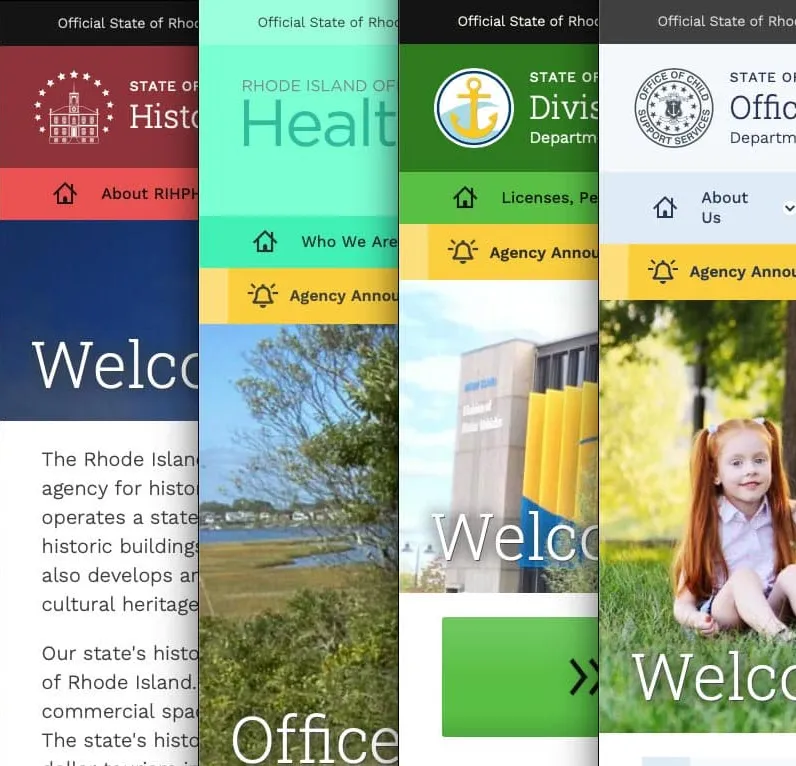
- Five themes on a disciplined palette. Site authors choose from five color themes, each supporting light and dark viewing, each built on a palette of 27 colors plus 12 transparents, and each tested to full WCAG conformance in both modes. Variation within a family — an agency looks like itself and still looks like the state.
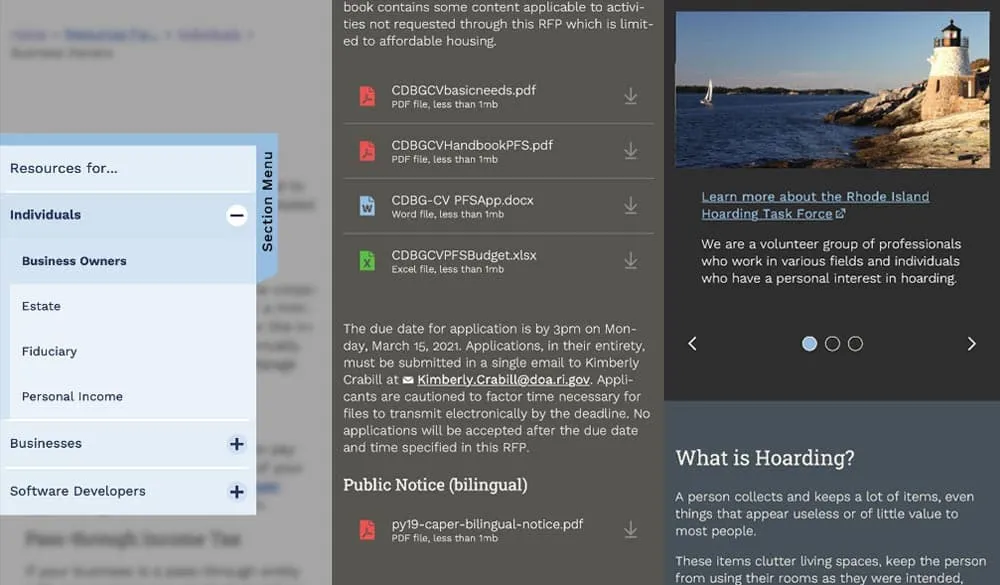
- Designed at phone size before desktop size. The section menu stays within reach of a thumb. Downloads state their file type and size before a tap spends anyone’s data — a courtesy that is also an accessibility feature on a shaky connection. Galleries swipe on a phone and take a keyboard on a desktop, the same content meeting each device on its own terms.
- A performance budget on every page. Components are built as light as they can be, with the least code and the smallest assets. Speed is treated as an accessibility feature, because for a citizen on a slow connection it is one.
- And a WAF/CDN in front of all of it. Content delivery stays fast and the platform stays up through attack traffic and event-driven spikes — the days a government site exists for.
Where it stands
- An Acquia Engage Award, 2022. Winner in Doers — Leader of the Pack, Public Sector, in Acquia’s 2022 Engage Awards — and a Government Experience Award the same year, for the state government experience the platform carries the state’s name into.
- The design system is still in production. Checked in August 2026: the design system’s markup is running across Business Regulation, Health, Labor and Training, Environmental Management and the Attorney General’s office. A bespoke system that is still the state’s front door four years later has outlasted the usual life of one.
- And the preference controls survived too. Color scheme, font size, line spacing, word spacing and language are still one click from every page. Accessibility features tend to be the first thing quietly dropped in a redesign. These were not.
News & Recognition
- October 2022
Rhode Island’s digital platform wins an Acquia Engage Award
Winner in Doers — Leader of the Pack, Public Sector, for the platform that puts roughly a hundred state agencies on one voice and one standard.
- September 2022
Rhode Island’s content platform wins a Government Experience Award
Recognized in State Government Experience by the Center for Digital Government, weeks before the same platform took an Acquia Engage Award.
Government website platform questions
How do you unify 100+ government agency websites?
One multisite platform with a shared design system on top. Rhode Island’s runs on Drupal and Acquia Site Factory with custom tooling: batch commands provision a new agency site in minutes, a migration helper reads content forward from the old properties, and hub-and-spoke syndication pushes one message from a parent agency to its children automatically — so saying the same thing everywhere is something the architecture performs rather than something dozens of teams coordinate by hand.
What does a state government design system include?
Components that make the rules self-enforcing. Rhode Island’s design system puts WCAG AA into every component and AAA into many — contrast, keyboard navigation, semantic labeling, ARIA handling and alt-text enforcement live at the component level — across five color themes that each support light and dark viewing. Visitors set their own reading terms: color scheme, font size, line spacing, word spacing and language.
How fast can a state launch new agency websites?
On Rhode Island’s platform, a new agency site is provisioned in minutes: batch commands stand it up, register it with the state’s syndication services and put authors in front of the editor. The platform itself went from first line of code to first launches in four and a half months, with 25 sites live within the first year.
Do state government websites have to meet WCAG?
Yes. The ADA’s Title II rule holds state and local government web content to WCAG 2.1 AA, on federal compliance deadlines — so accessibility on a government platform is a legal requirement, not a preference. Rhode Island reached that position structurally, with conformance built into the design system’s components before the mandate arrived.
How do government websites meet accessibility requirements?
By building the requirements into the components rather than auditing pages afterward. On ri.gov properties, accessibility is a property of the design system - WCAG AA throughout, many components at AAA - and Lighthouse accessibility and best-practice scores run consistently above 95%. Reading preferences under the visitor’s control extend that from compliance to inclusion.
What results does a state government platform deliver?
For the State of Rhode Island platform by Pare & Co: first launches four and a half months from the first line of code, 25 new agency sites within a year, three-to-four-times performance improvements over the sites they replaced, and two 2022 honors — an Acquia Engage Award in Public Sector and a Government Experience Award. Four years on, the design system is still the state’s front door.
Client leadership

Jack Hartman
Jack Hartman’s work has included the State of Rhode Island’s move to a unified digital presence, across roughly 100 agencies.