Showing 91,000 Veterinarians What Membership Buys: A Member Platform for the American Veterinary Medical Association
AVMA has been the authoritative voice of American veterinary medicine since 1863, and its 91,000 members renewed regularly while rarely using the site as the resource it was built to be. We rebuilt the platform so the value of membership is visible on it.

The work
The Challenge: An Authoritative Institution, an Aging Member Platform
AVMA has represented American veterinary medicine since 1863, and membership in it is professional affiliation with the body that advances the science and practice of the field. Its website is the main communications vehicle for the organization, serving more than 91,000 members, mostly doctors, in a profession that works across clinics, surgical settings, farm visits and conference halls.
The platform had grown past what its framework could deliver. It was not mobile-friendly, the site tree recorded years of publishing rather than anything a veterinarian came to do, and the resources included with membership were not clearly illustrated anywhere a prospective member would look. Members renewed regularly while using the site less than they could, and someone deciding whether to join could not see what they would be buying.
The Strategy: A Research-Led Association Redesign on Drupal
Put members first, and treat the site map, search, mobile and the case for membership as one piece of work.
- Research before architecture. A ten-organization competitor analysis, a member survey, content and SEO audits, stakeholder workshops with on-the-spot surveys at the annual convention, and phone interviews with volunteers and members. The research set the design decisions rather than ratifying them.
- The architecture came from a card sort. More than 200 cards, sorted by six groups from throughout the organization, set the new site tree, which was then tested with the audiences it serves.
- Drupal, integrated with the systems an association runs on. Aptify member management connected through single sign-on, content migrated from SharePoint, WordPress and CSV files, and hosting on Acquia.
- The brand brought up to WCAG. Refreshed typefaces, colored typography darkened to meet WCAG thresholds and a component set AVMA’s editors use to build marketing pages themselves.
The Outcomes: A Platform That Shows What Membership Buys
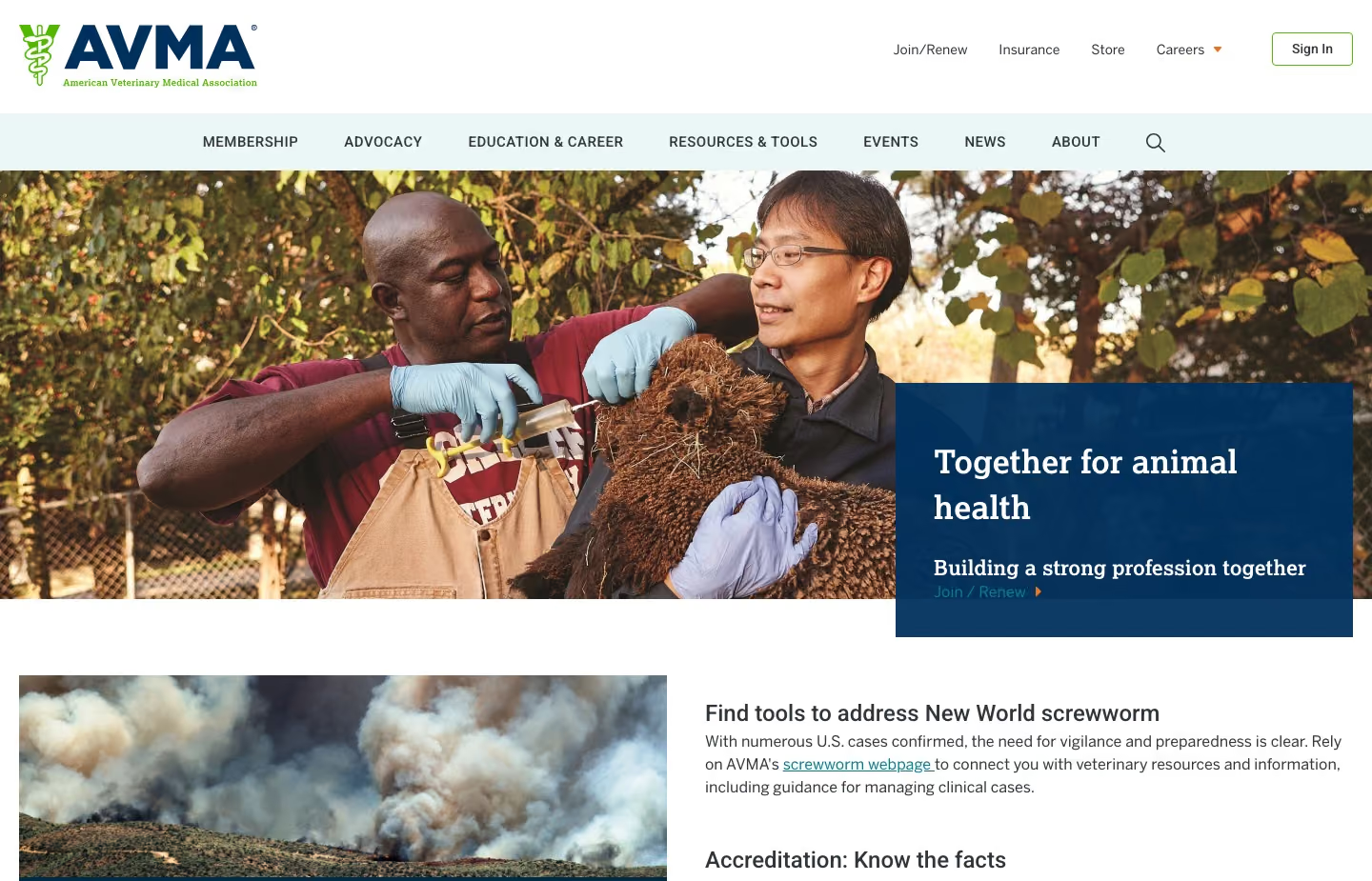
The main brand vehicle came fully into the modern web: large headlines, a clearer hierarchy, a mega-menu that breaks complex navigation into digestible parts and convention pages with a sub-navigation of their own. Benefits and resources are stated on the pages where someone decides whether to join and where an existing member decides whether to come back — and the first entry in the navigation is Membership.
The public gets its share of the mission too: pet health information, animal welfare guidance and recall notices are findable by anyone. And the rebuild was recognized twice at the Communicator Awards, at Silver in Associations and in Visual Appeal & Function.
The detail
Why it mattered
- The main communications vehicle for the organization. AVMA advocates on behalf of more than 91,000 members, mostly doctors along with veterinary support staff, and has roots reaching back to 1863. It is the most widely recognized member organization in the field, and the website is how that organization speaks.
- A strong brand, delivered on an aging framework. The site had grown past what its framework could deliver: not mobile-friendly, in a profession that works across clinics, surgical settings, farm visits and conference halls. The brand was strong; the screen had stopped keeping up with it.
- A site tree that recorded publishing history. Years of content had been added as it arrived — policy, guidelines, benefits, news, events, education, advocacy — so the tree reflected the order things were published in. On a site this content-rich, search and structure decide whether a motivated member finds the document they came for.
- Benefits that were never actually stated. The resources included with membership were not clearly illustrated anywhere a prospective member would look. Members renewed regularly while using the site as a resource less than they could, and someone deciding whether to join could not find out what they would be buying.
How it was built
- Research before architecture. A competitor analysis of five direct competitors and five similar membership organizations, an online survey of the existing audience, content and SEO audits, in-person stakeholder workshops including on-the-spot surveys at the annual convention, and phone interviews with volunteers, members and stakeholders. The research set the design decisions rather than ratifying them.
- The architecture came from a card sort. More than 200 cards, sorted by six groups from throughout the organization, produced the new information architecture, which was then tested with the audiences it serves. Content modeling, more than a dozen wireframes, three style tiles, wireframe user testing and technical audits followed before full design mockups.
- One rebuild, four problems. The site map, search, mobile and the communication of member value were treated as a single piece of work, because fixing any one of them alone would have left the platform failing at the other three.
- Drupal, integrated with the systems an association runs on. Drupal, with Aptify member management connected through single sign-on, content migrated from SharePoint, WordPress and CSV files, and hosting on Acquia.
- The brand brought up to WCAG. The style explorations refreshed the typefaces, darkened colored typography to meet WCAG thresholds and added tints for design variability, with a component set editors use to build marketing pages themselves.
What it changed
- Each page’s purpose shines. Large headlines and images, chunks of color and a clearer hierarchy of information brought the main brand vehicle fully into the modern web. A mega-menu breaks complex navigation into digestible parts, with icons and color differentiating the important sections, and the yearly convention pages gained a sub-navigation of their own.
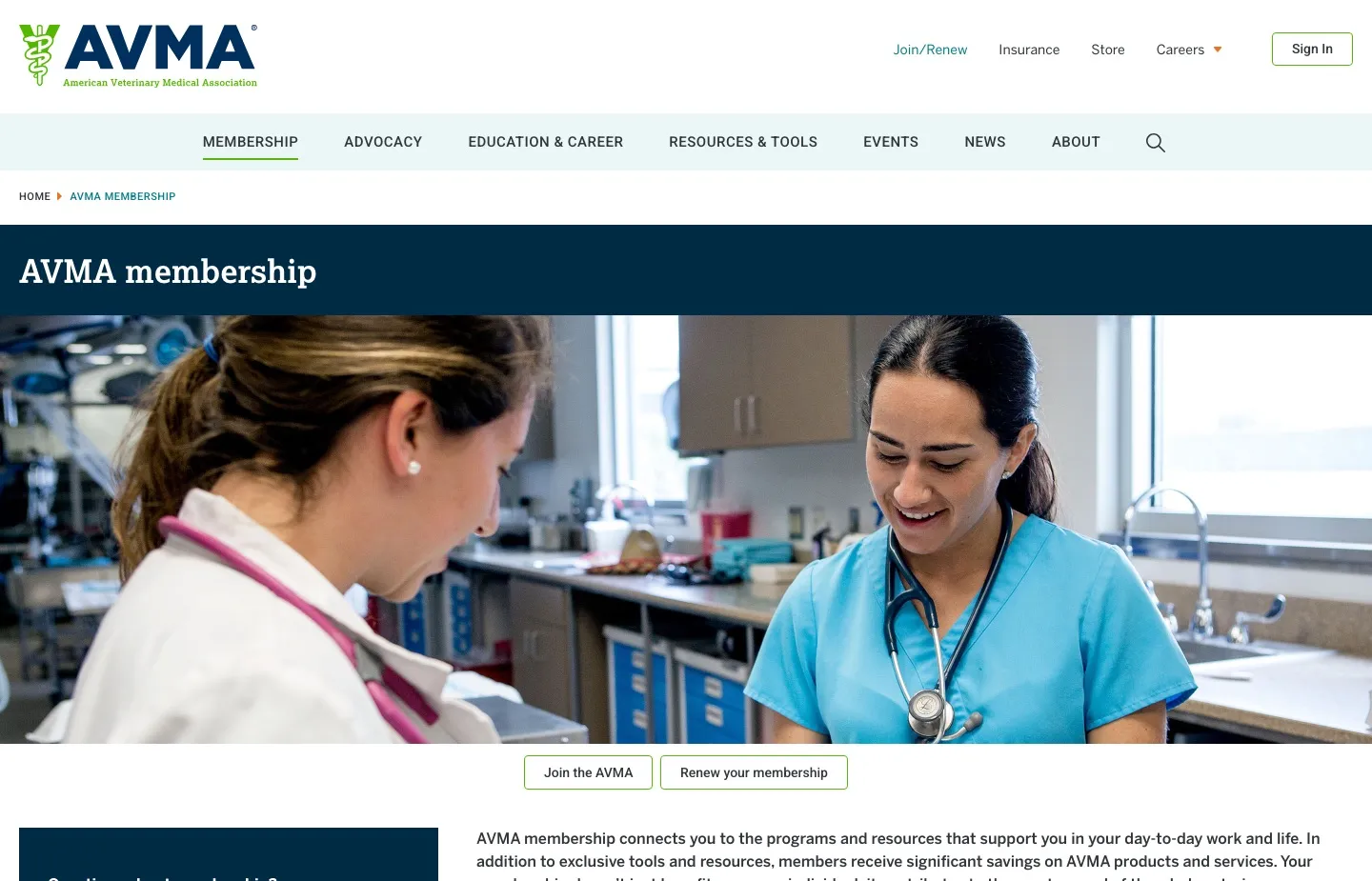
- Membership has a surface again. Benefits and resources are stated on the pages where someone decides whether to join and where an existing member decides whether to come back — and the general public can find pet health information, animal welfare guidance and recall notices, which is the association’s mission working in public.
- Recognized twice. Two Communicator Awards at Silver, in Associations and in Visual Appeal & Function: an outside read on a rebuild whose brief was to make an institution’s authority legible on screen.
Association website redesign questions
What does an association website redesign involve?
Research before architecture. AVMA’s began with a competitor analysis of ten organizations, an online member survey, content and SEO audits, stakeholder workshops including on-the-spot surveys at the annual convention, and phone interviews with volunteers and members. The design work that followed ran from information architecture and audience testing through wireframes, style tiles and full mockups with a flexible component architecture.
How does an association website communicate the value of membership?
By stating the benefits where people decide. AVMA’s resources and benefits were not clearly illustrated anywhere a prospective member would look, so the rebuild put them on the pages where someone decides whether to join and where an existing member decides whether to come back — starting with a navigation whose first entry is Membership.
How do you reorganize a large association’s site structure?
With the members’ own mental model. AVMA’s information architecture came out of a card sort of more than 200 cards run with six groups from across the organization, followed by audience testing of the new structure. Years of content accumulation had organized the site in the order things were published; the new tree is organized around what a member comes to do.
What platform integrations does an association website need?
The membership system, above all. AVMA’s site runs on Drupal, integrated with Aptify member management through single sign-on, with content migrated from SharePoint, WordPress and CSV files and hosting on Acquia.
Client leadership

Jack Hartman
Jack Hartman’s specialty is audience experience at institutional scale. He has led member platforms where the job is showing 91,000 people what they are already paying for.