
Opening Two Doors to One Catalog: A Global Storefront for Leica Geosystems
Leica’s customers arrive in two states of mind — exploring or buying — and the buying runs to $80,000 laser scanners in an ordinary cart. We built two different sites for them, on one architecture, across multiple countries and six languages.
The work
The Challenge: Every New Country Made the Platform Heavier
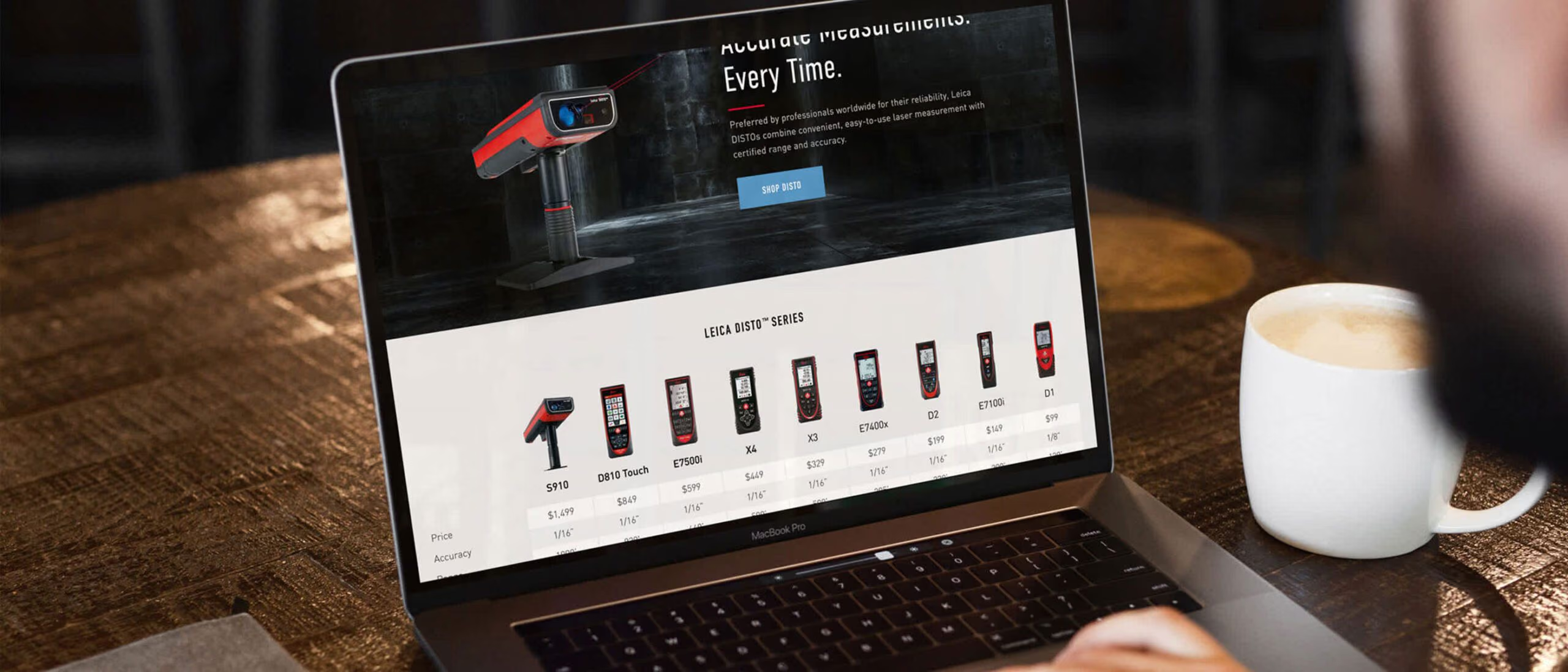
Leica Geosystems has made precision instruments since Heinrich Wild’s first rangefinder in 1921, and today sells measurement online across a catalog that runs from a $99 laser measure to an $80,992 laser scanner — to professional surveyors putting five-figure instruments in a cart and to remodelers researching a first purchase — the same brand, the same product line, two entirely different buying behaviors. Underneath, a multisite architecture gave every country its own admin, its own catalog, its own translation pipeline and its own update cycle, so every new market meant more maintenance, until the marketing team’s capacity was going to upkeep rather than to the business.
The Strategy: One Commerce Install and Two Doors, Learn or Shop
Two calls, one architectural and one experiential.
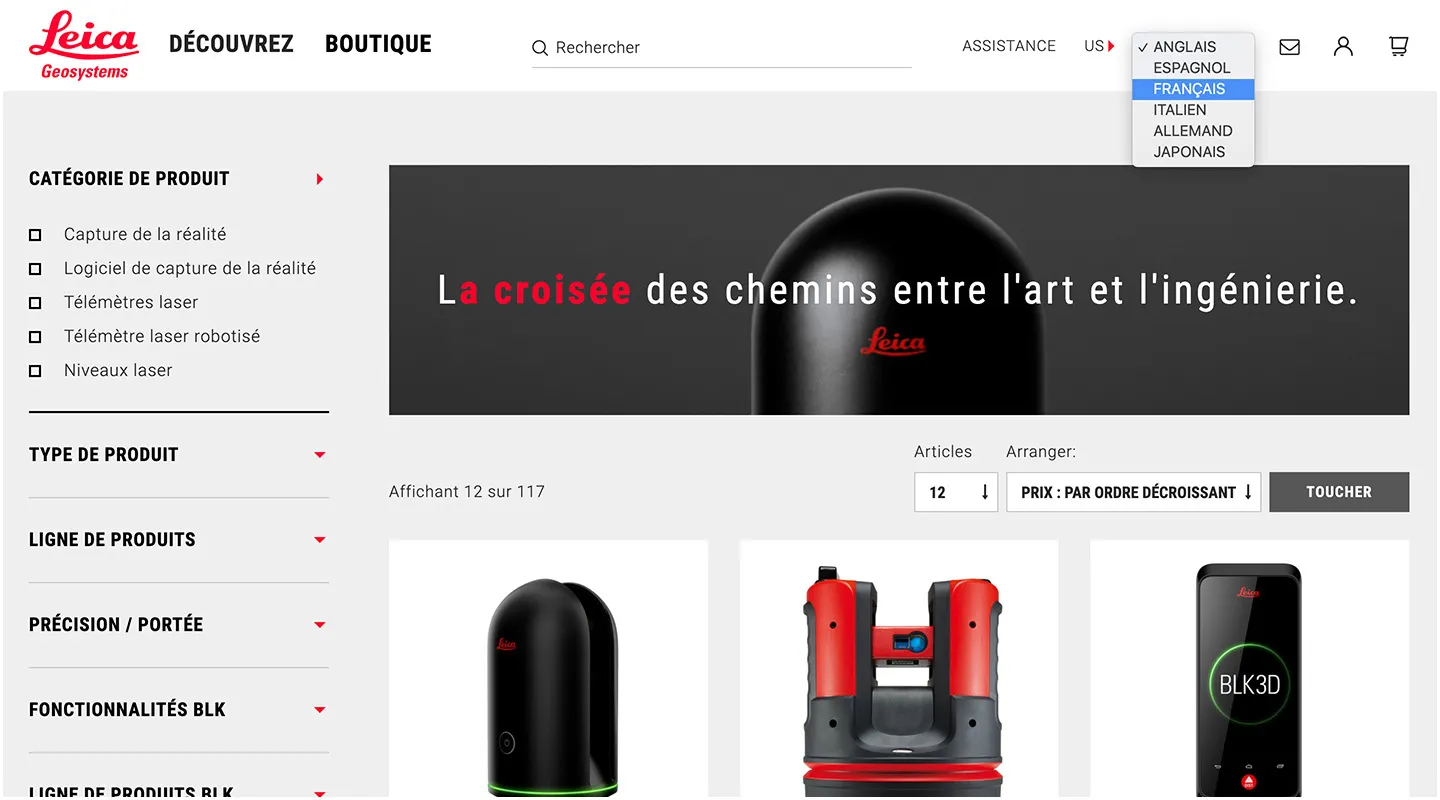
- Collapse the multisite into one site. Configuration management had by then arrived in core, making it viable to run a single Drupal install with country-specific behavior through Domain Access — one database, one admin, one catalog, one Drupal Commerce installation with multiple stores and price lists over it.
- Split the site by intent, not by topic. Customers do not arrive looking for a category. They arrive exploring or buying, so the navigation was built around state.
- Let the customer choose the door. Learn is unapologetically marketing — video, VR demos, sample data, comparisons. Shop is unapologetically transactional — specs, options, bundles, warranties, no marketing. Both serve the same catalog on the same architecture.
The Outcomes: One Platform to Run, New Stores on Demand
One platform to run, and two experiences that stop taxing each other.
- Growth | A buyer path built for completion rather than persuasion, with checkout simplified against real buying patterns | An explorer path in a brand register matched to a premium technical product
- Engagement | One catalog, one admin, one translation pipeline, one configuration export across every market | New country stores added on demand instead of provisioned and rebuilt
The detail
Why it mattered
- Every gain in geographic reach added operational drag. The multisite architecture gave each country its own site, its own admin, its own product catalog, its own translation pipeline and its own update cycle. That served the business when the international operation was smaller. It scaled the wrong way.
- The cost showed up in the marketing team’s day. No single sign-on across country sites, so multiple admin logins. Updates and patches run and tested on every site individually. Each country maintaining its own product list, feature definitions and prices. Translations sent to each site separately, multiplying localization across countries.
- Capacity was going to the platform instead of the business. Campaigns, product launches, content and conversion work were being crowded out by maintenance, which is the quiet version of a platform failing.
- The experience did not know who had walked in. Customers ranged from professional surveyors making five-figure decisions to DIY remodelers researching a first laser measure. Every visitor met the same blend of education and commerce. A heavy marketing experience obstructs a buyer ready to check out; a clean transactional one loses the explorer who has not decided yet.
How it was built
- The architectural call: collapse the multisite into one site. Configuration management had by then arrived in core, which made it newly viable to run a single site with country-specific behavior through Domain Access. One database, one admin, one set of products, one Drupal Commerce installation with multiple stores over a single catalog. Country pricing through price lists. Content authored once, released to specific countries, translated through one pipeline. One configuration export that moves cleanly between environments and lives in version control.
- Which is not the obvious move from inside a working multisite. The instinct is to optimize the existing structure rather than replace its foundation. The opposite position was taken here: the structure itself was the friction, the patterns had matured enough to do better, and the upgrade path forward was a deliberate part of the recommendation because the architecture had to last.
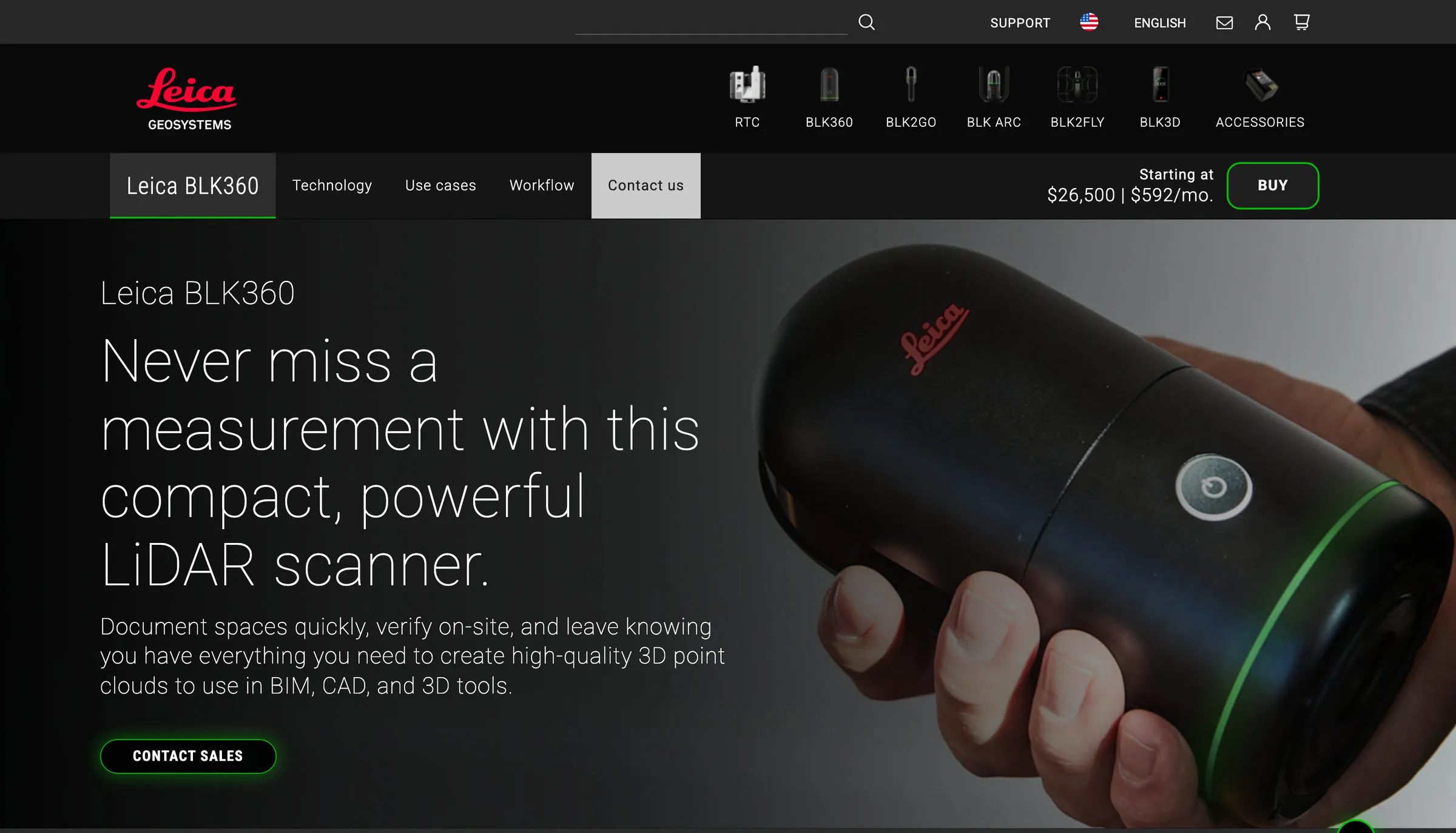
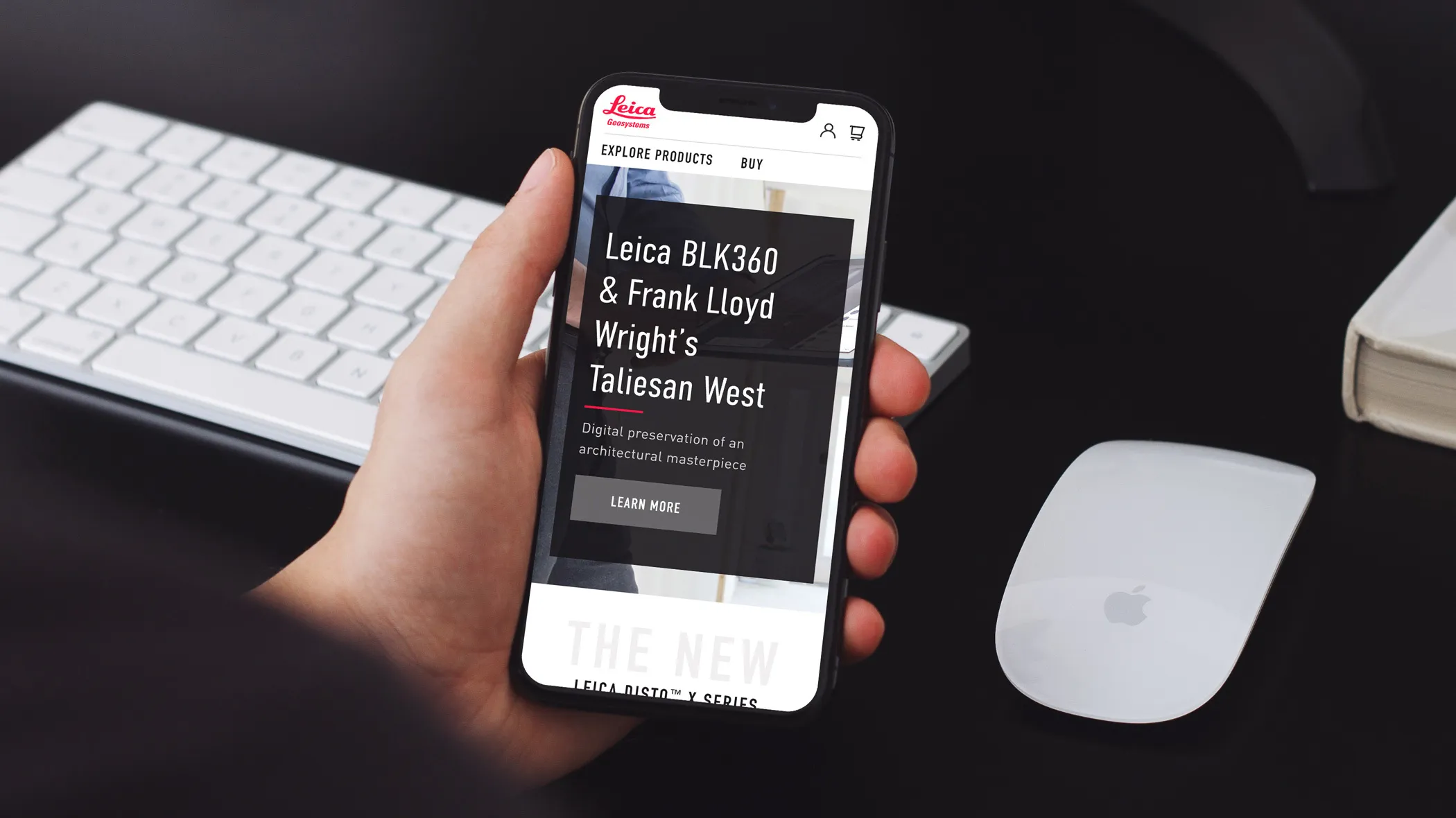
- The experiential call: split by intent, not by topic. Most product sites organize navigation around what — categories, product lines, features, support. Leica’s customers do not arrive looking for a category. They arrive in one of two states, exploring or buying, so after many rounds of testing the navigation settled on something radically simple: Learn or Shop. The timing mattered — the BLK360’s 2018 launch had repositioned the brand as sleek and easy to use, and the site had to live up to the product.
- The Learn side is unapologetically marketing. Large imagery, video, embedded VR product demos, sample data files, comparisons, articles, reviews. Built to educate a visitor who has not decided, in a brand register matched to a premium technical product.
- The Shop side is unapologetically transactional. Specs, options, software bundles, warranties, no marketing. Built for a visitor who has already decided and is now executing — and executing at real money: the shop sells scanners at $46,000, $62,000 and $80,992 through the same cart as a $99 DISTO. Checkout was simplified against buying patterns studied from previous iterations of the site, to find where friction could come out and where choice had to stay.
What moved
- The teams operate one site, not many. Updates run once. Translations run once. Products are managed in one catalog. Configuration moves cleanly between environments. New country sites can be added on demand rather than provisioned and rebuilt.
- The day stopped being about the platform. The capacity that had gone to maintenance went back to the work the platform exists to enable.
- The conversion architecture acknowledges two states. Buyers ready to purchase get a path designed for completion rather than persuasion. Explorers get a brand experience matched to a premium technical product. Neither audience is taxed with the other’s content.
News & Recognition
- June 2020
Two Communicator Awards for Leica Geosystems
Excellence in Shopping and Distinction in Construction, a year after the same commerce platform took a Davey Silver.
- October 2019
Leica Geosystems takes a Davey Silver
Silver in the Construction websites category, for a commerce platform serving buyers who arrive either to learn or to buy, and almost never both.
Global e-commerce platform questions
How do you run one e-commerce site across many countries?
One installation with country-specific behavior, not one site per country. Leica’s storefront runs a single Drupal install with Domain Access: one database, one admin, one product catalog, one Drupal Commerce installation with multiple stores over it, country pricing through price lists, and content authored once, released per country and translated through one pipeline across six languages.
Is multisite or a single site better for global e-commerce?
Multisite scales the wrong way once every country is a silo: separate admin logins, updates run and tested site by site, each country keeping its own product list and prices, and every translation sent separately. Leica’s consolidation collapsed all of that into one of each — and new country stores are now added on demand rather than provisioned and rebuilt.
How should a premium product site organize its navigation?
Around the visitor’s state of mind, not the catalog. Leica’s customers arrive exploring or buying, so the navigation is radically simple — Learn or Shop. Learn educates with video, VR demos, sample data and comparisons in a register matched to a premium technical product; Shop delivers specs, options, bundles and warranties with no marketing in the way.
What makes a high-consideration checkout convert?
Assuming the buyer has decided. Leica’s Shop side sells laser scanners at up to $80,992 through an ordinary cart, so the checkout is built for completion rather than persuasion: simplified against buying patterns studied from previous iterations of the site, keeping the choices that matter — software bundles, warranties — and taking out the friction that does not.
What results does a global e-commerce consolidation deliver?
For the Leica Geosystems storefront by Pare & Co: one admin, one catalog, one translation pipeline and one configuration export across every market, with new country stores added on demand — and a conversion architecture that stops taxing each audience with the other’s content. The relationship behind it goes back to 2014, across multiple projects since.
Client leadership

Jack Hartman
Jack Hartman came up through agencies in New York and Philadelphia. He has led commerce work where two very different buyers share one catalogue.