
Modernizing the Platform Global Health Policy Runs On: A Rebuild for the Institute for Health Metrics and Evaluation
The Institute for Health Metrics and Evaluation is the research institution behind the Global Burden of Disease study — data that decides how WHO, governments and global health organizations allocate billions in public health resources. We modernized the digital platform that delivers that data to the audiences whose decisions depend on it.

The work
“You all are a fantastic team — professional yet personal; dedicated but not stressed; efficient, well-planned, and organized. Thank you so much and we look forward to more projects together in the future!”
The Challenge: The Platform Behind Global Health Policy Was Out of Runway
healthdata.org — the platform of the Institute for Health Metrics and Evaluation, based at the University of Washington School of Medicine — is where the Global Burden of Disease study meets the people who allocate against it — governments setting national health priorities, WHO setting global agendas, foundations directing philanthropic investment, journalists reporting the trends. The study behind it runs to 607 billion-plus standardized estimates across 463 health outcomes and risk factors for 204 countries. By 2022 the platform carrying it was on a release approaching end-of-support, with a content model that put engineering in the path of every new layout, a security architecture built to earlier practice, and a new institutional design language waiting to be implemented.
The Strategy: One Rebuild for the Migration, the Design System and the Security
Ran the migration, the design implementation, the content model rebuild and the security overhaul as one engagement on Drupal, rather than sequencing four disruptions through a platform the global public health community depends on.
- The content model rebuilt around how the team authors. Several rounds of modeling and architecture diagramming right-sized the components, with IHME’s full-page designs converted into annotated flex content diagrams down to the field level.
- Maintainable inside academic resource constraints. The range of content IHME publishes, on a model a small team can keep running.
- Availability protected throughout. The audience’s work depends on the platform staying reachable and trustworthy during the transition, not after it.
The Outcomes: A Research Platform Its Own Team Composes
An institutional surface that reads like the standard the research behind it already is.
- Trust | Off an end-of-support release, onto current security and SSO architecture | A design language IHME’s own team authored, implemented as a functional and accessible platform
- Engagement | Landing page layouts the team composes without engineering in the path | A Digital Health Award, Bronze, in its first year
- Intelligence | A teaser module that became the seed of an open-source Drupal module | The component library argued at field level before it was built
The detail
Why it mattered
- The platform was out of runway, not merely dated. The release it ran on was approaching end-of-support. Continuing without re-platforming meant accumulating security exposure, maintenance burden and architectural fragility — conditions a globally referenced public health platform cannot live with indefinitely.
- The content model was constraining what the team could publish. IHME publishes research findings, dataset documentation, policy briefs, news, events and multimedia, and needed full control over landing page layouts to cover that range. Every new content type or layout pattern required engineering, which set the publishing cadence below what the field moves at.
- The security architecture predated the institution’s current needs. Endpoints and authentication had been built to earlier practice. Integrating with modern SSO providers and contemporary standards for institutional research platforms needed an overhaul rather than an increment.
- A new institutional design was already coming online. IHME’s internal design team had produced a fresh visual identity and page design language that had to be translated into a functional, accessible platform. Running the design implementation, the migration and the security overhaul as three engagements would have been operationally fragmented and budget-inefficient — which meant one partner running all three threads without dropping any.
- Credibility is part of what the platform delivers. Research institutions live on credibility, and a platform that reads as outdated or technically thin diminishes the perceived rigor of research that has not changed. For an institution whose authority rests on being the global standard for population health metrics, the digital surface has to read as the global standard too.
How it was built
- One engagement, four interlocking threads. The migration, the design system implementation, the content model rebuild and the security architecture overhaul were sized and run as a single effort, because doing them separately would have meant sequencing four disruptions through a platform the global public health community depends on staying available.
- The content model, rebuilt around how the team actually authors. Several rounds of content modeling and architecture diagramming right-sized the number and type of components. IHME’s full-page designs were converted into annotated flex content diagrams showing how the proposed architecture would function down to the field level, so the model could be argued before it was built.
- Maintainable by the team that has to maintain it. The result supports the range of content IHME publishes while staying within reach of a team under the resource constraints typical of academic research institutions — which is the constraint that decides whether a content model survives its first year.
- A feature audit with three verdicts. Every existing feature — out-of-the-box, plugin and custom — went onto one list and got a verdict: drop, replace or upgrade. The custom features that made the grade were rewritten for the migration rather than dragged across.
- A teaser module that outgrew the engagement. IHME’s design leans on content teasers whose fields change with placement — one shows authors, another only a journal title. The module built to express all of those rules in one place went on to inspire Shared Fields Display Settings, an open-source Drupal module the firm develops.
- A design system the team drives by drag and drop. A visual page builder over the component library, with customizable templates and a customized slider layout — so feature-rich pages are composed in the editor, to WCAG 2.1 conformance, with no engineer in the path.
- Security brought to current practice. Security endpoints were overhauled and single sign-on integrated with OneLogin, bringing authentication to the standard a globally referenced research platform is expected to meet.
What the platform answers for
- The audience is decision-oriented and does not have time. Researchers downloading datasets, policy makers exploring visualizations, journalists investigating trends, public health professionals looking for one specific number to make one specific decision, funders evaluating impact, students learning from the analysis. Every one of them is on the platform to act on something.
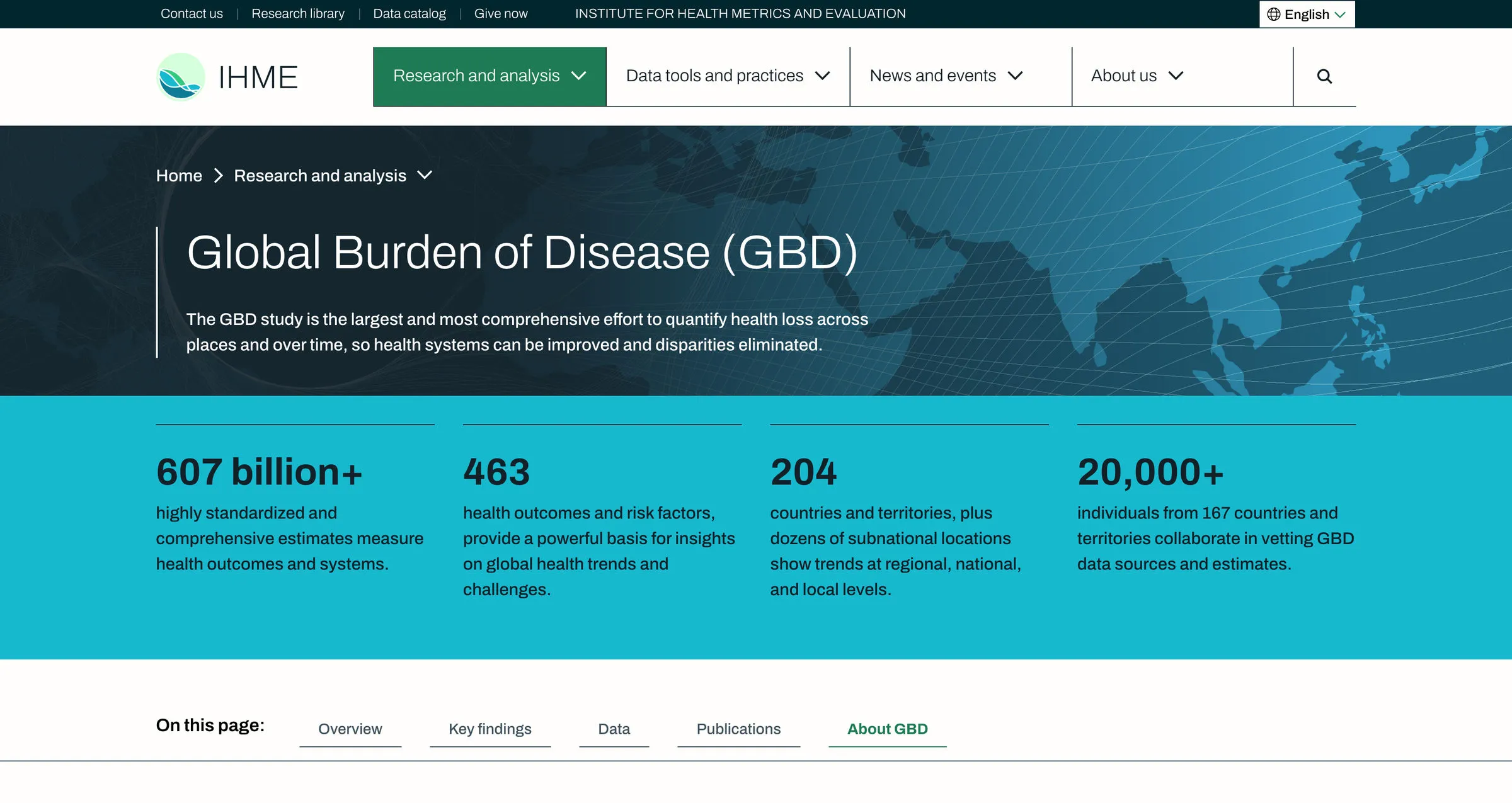
- The scale of the study behind it. IHME publishes the Global Burden of Disease as 607 billion-plus standardized estimates across 463 health outcomes and risk factors, for 204 countries and territories plus dozens of subnational locations, vetted with more than 20,000 collaborators in 167 countries.
- Who acts on it. Governments prioritize national health investment against it, WHO references it in setting global health agendas, major foundations direct philanthropic investment with it, and NGOs design interventions around it.
Research institution website questions
How do you migrate a large research website without disrupting it?
Run the moves as one engagement instead of sequencing disruptions. IHME’s migration off an end-of-support release, its design system implementation, its content model rebuild and its security overhaul were sized and executed as a single effort, because healthdata.org is a platform the global public health community depends on staying available.
How do you give a research team control of its page layouts?
Model the content around how the team authors, then let them build visually. IHME’s full-page designs were converted into annotated flex content diagrams down to the field level so the architecture could be argued before it was built, and a drag-and-drop page builder over the component library means feature-rich pages are composed in the editor, no engineering in the path.
What does a website feature audit involve?
One list, three verdicts. Every existing feature on healthdata.org — out-of-the-box, plugin and custom — was cataloged and judged: drop, replace or upgrade. Custom features that made the grade were rewritten for the migration, which is how a platform sheds a decade of accumulation without losing what its team relies on.
How should a research platform handle security and single sign-on?
As an overhaul, not an increment, when the architecture predates current practice. IHME’s security endpoints were rebuilt and single sign-on integrated with OneLogin, bringing authentication to the standard a globally referenced public health platform is expected to meet.
What does modernizing a research institution's platform achieve?
For the healthdata.org rebuild by Pare & Co: a platform off an end-of-support release and onto current security and SSO architecture, IHME’s own design language implemented as an accessible WCAG 2.1 platform, landing pages the team composes without engineering, a Digital Health Award Bronze in its first year — and a teaser module that seeded an open-source Drupal module. The firm still runs the platform.
Client leadership

Matthew O’Bryant
Matthew O’Bryant’s specialty is federation-scale platforms, and the one global health policy runs on is answerable to every institution that cites it.