
Earning Trust Before Asking for an Application: A Fintech Lending Platform for One Percent for America
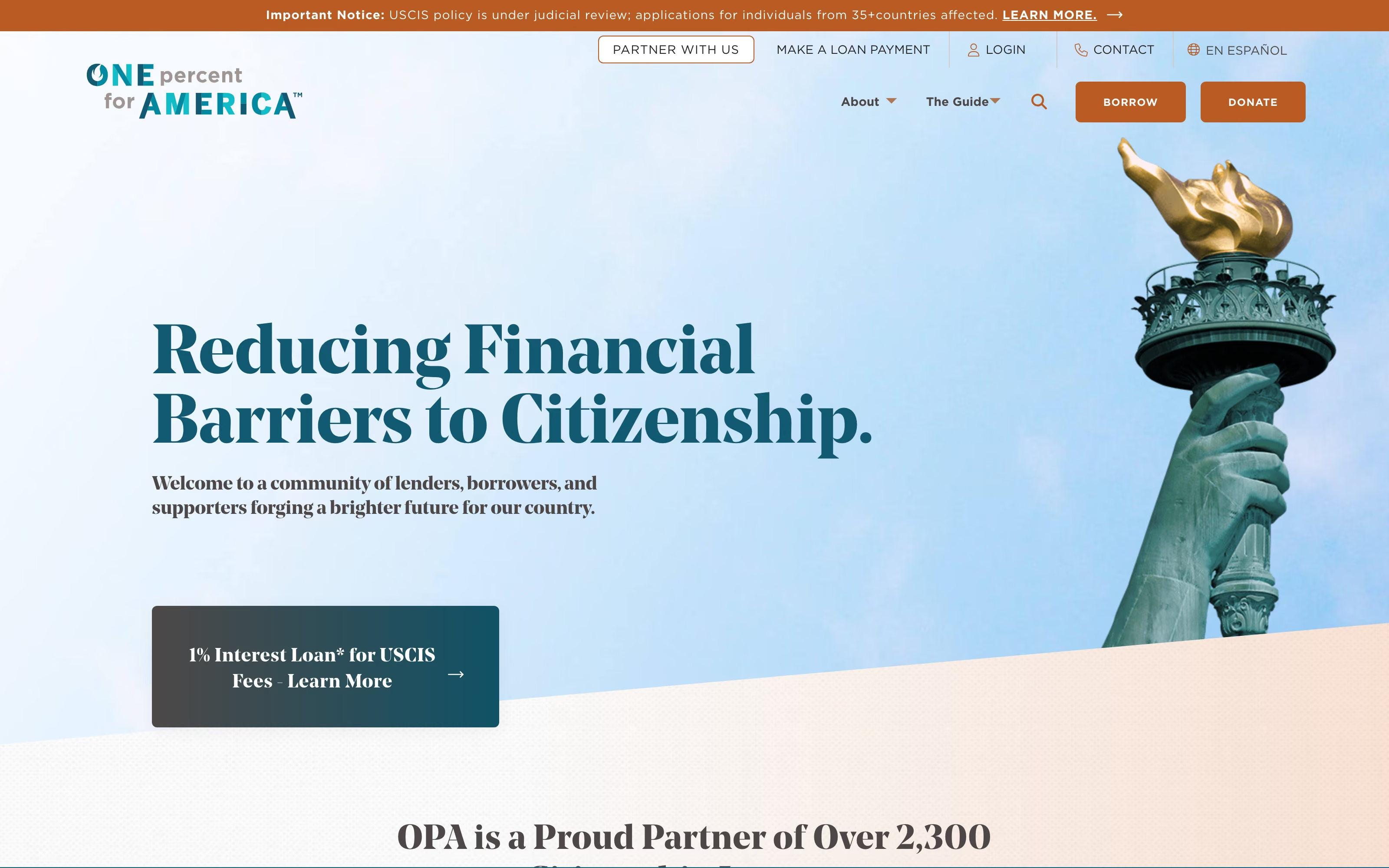
One Percent for America offers 1% interest loans to cover citizenship application fees — a fintech product built for an audience that other lending platforms have actively misled. The platform had to earn trust before it could process a single loan, and every design decision was sized for that work.

The work
The Challenge: A 1% Loan for People Payday Lenders Reached First
Roughly 9 million immigrants in the United States are eligible for citizenship and around 8 million have not applied. The fees — $500 to $1,200 — are among the most consistent reasons given, and the people inside that gap have usually been reached first by payday lenders and high-interest cards. A platform offering 1% has to survive their skepticism before it can process a single loan.
The Strategy: A Citizenship Loan Platform Built as a Trust System
Designed as a trust system first and a feature set second, with Salesforce as the record and Drupal as the interface over it.
- Two entrances, because there are two populations. Borrowing and investing are separate paths from the header down, each with its own workflows, and neither is made to walk through the other’s.
- Paths sized to where the borrower already is. A short route for someone waiting only on funding, a longer one for someone still working out whether they qualify.
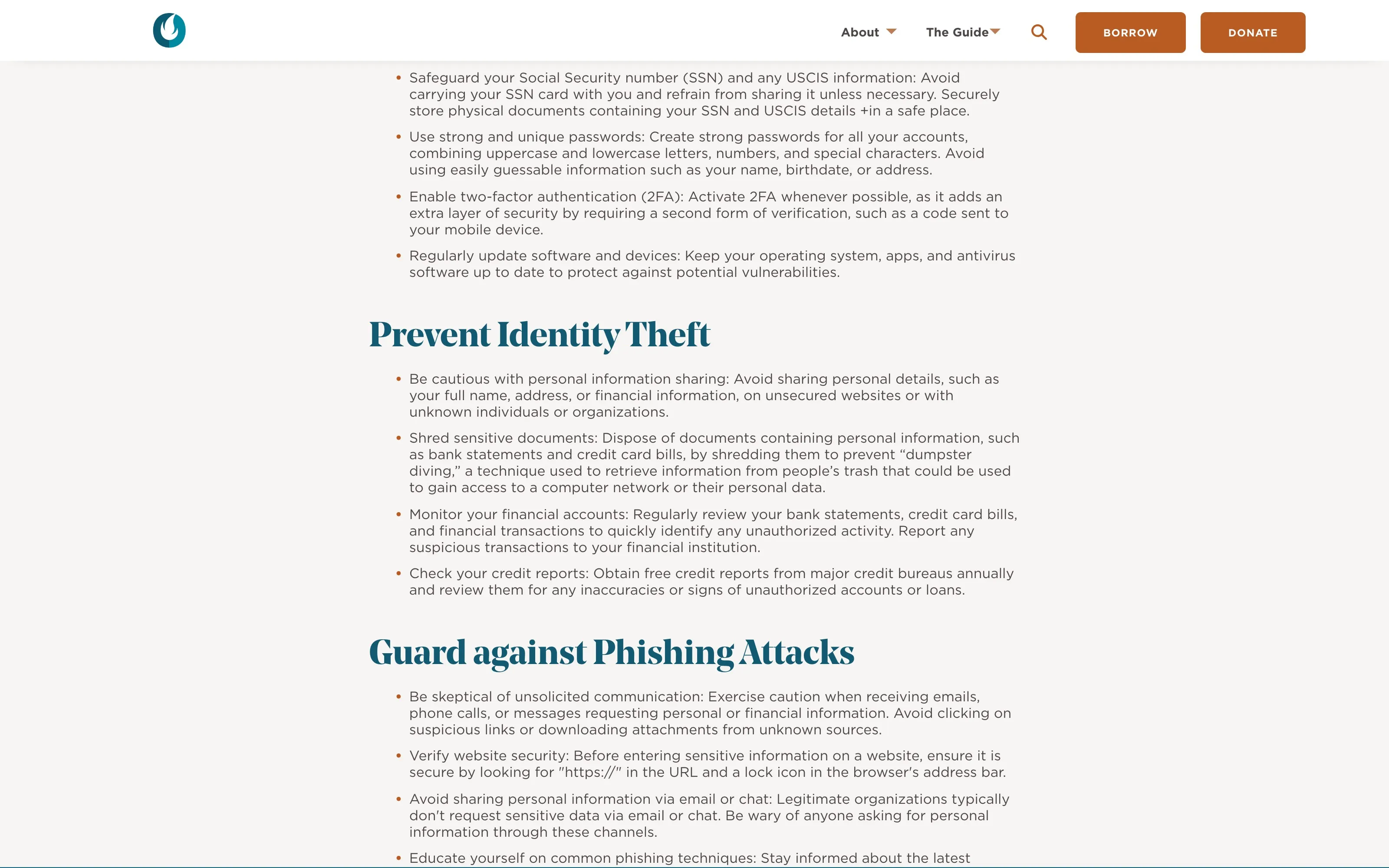
- The guidance is the credential. Citizenship, money and credit written out in full and given away, including how to recognize the financial fraud aimed at this audience.
- Mobile as the primary case. Not a reduced copy of a desktop product, because for much of this audience the phone is the only access there is.
The Outcomes: 2,300+ Citizenship Journeys and Two Anthem Golds
A lending product for people who have been given good reason to distrust lending products — and the inaugural Anthem Awards gave the work Gold twice, in Human and Civil Rights for both Innovation and Service.
- Trust | The 1% claim published with its conditions rather than its conditions buried | Interface and system of record agree at every step, including “not yet”
- Growth | Two-sided marketplace serving borrowers and crowdfunded investors on one platform | 2,300+ citizenship journeys by OPA’s own count
The detail
Why it mattered
- The audience was structurally suspicious of financial products. A new lending platform promising 1% interest is exactly the pitch this audience had learned to mistrust. The first trust problem was not building credibility from zero — it was building credibility against an existing pattern of betrayal, so every visual choice and every workflow ran into justified skepticism.
- Two populations on opposite sides of one marketplace. Borrowers needed eligibility verification, simple loan workflows and guidance on the citizenship process itself. Investors needed transparency into capital flows, a choice between donating and lending short-term, maturity tracking and a decision at the end of each term. Both had to feel safe, and the connection between them had to be tangible without either side losing privacy.
- The regulated workflows ran deep beneath what anyone would see. Account creation, security checks, loan applications, financial-institution connections, servicing, investor capital management, electronic transfer to USCIS. Each came with compliance requirements, error states and integration dependencies.
- Mobile could not be the cut-down version. Much of this audience reaches digital products through a phone and often has no regular desktop access. A mobile experience that felt like a lesser copy of the real platform would have signaled the second-class treatment other financial products had already given them.
The call and the build
- A trust system first, a feature set second. Most fintech earns trust through brand familiarity, peer proof or a known institution standing behind the product. OPA had a mission, an interest rate that sounded too good to be true, and a funding model the audience had never encountered. Trust had to be built in layer by layer instead.
- Workflows sized to where the borrower already is. Someone through the paperwork and waiting only on money needs a short path — account, security check, application. Someone earlier needs depth about eligibility and what is coming. The platform serves both without making either walk through the other’s experience, which is itself the signal that it understands who is using it.
- An investment designed as a cycle. Funders choose between a tax-deductible donation and a short-term loan, and at maturity the choice comes back: lend again, convert to a donation or withdraw. Maturity dates sit beside the Lend Again and Donate actions, borrower testimonials on the dashboard show who an investment helps, and a borrower can become an investor — the circle the platform is named for.
- A universal web app rather than a mobile app. One build that works anywhere, on any device, instead of a website plus an app to maintain beside it. Step-by-step workflows, large touch targets, generous form spacing and soft, readable type make signing up or applying for a loan as easy on a phone as at a desk.
- Substantive guidance, given away rather than gated. The Guide runs three tracks — the pathway to citizenship, managing money and building credit — with the N-400 checklist, the naturalization test and fraud prevention written out in full. Nothing sits behind a sign-up wall and nothing upsells a premium tier. Language and photography were calibrated to authenticity rather than to aspirational financial-services tropes.
- Salesforce as the system of record. Eligibility, documentation and the state of a loan all live there, which makes the integration a trust problem rather than a plumbing one. An applicant told one thing by the interface and something else by the institution has no reason left to believe the 1% claim either, so the surface and the record agree at every step — including the steps where the answer is “not yet”.
- A Drupal interface built over that record. Loan applications tend to look like the process that produced them: a form serving the institution’s internal structure, and the borrower asked to be grateful for it. This one is built for the person filling it in — plain language about what each step is for, visible progress through a process that takes weeks, and no dead ends where an applicant is left with a status they cannot interpret.
Where it stands
- The platform is doing the job in public. OPA’s own site now counts more than 2,300 citizenship journeys it has been a partner to, and puts named borrowers rather than stock testimonials behind that number.
- The terms are on the page, not behind it. The 1% rate shows its conditions in plain sight — approval requirements, an employed co-borrower, and what happens if a payment runs 90 days late. For a product whose whole difficulty is sounding too good to be true, publishing the catch is the argument.
Fintech lending platform questions
How do you build trust into a lending platform?
Publish the catch, and make the surface agree with the record. On the One Percent for America platform the 1% rate sits beside its conditions — approval requirements, an employed co-borrower, what happens at 90 days late — and the interface and the system of record agree at every step, including the steps where the answer is not yet. The guidance is the other half: citizenship, money and credit education given away ungated, including how to recognize the financial fraud aimed at exactly this audience.
How does a two-sided lending marketplace work?
Two entrances, one cycle. Borrowers get eligibility checks, a loan workflow sized to where they are in the citizenship process and plain-language guidance. Investors choose between a tax-deductible donation and a short-term loan, and at maturity choose again: lend again, donate or withdraw. Borrowers can become investors, which closes the circle the platform is built around.
Should a lending platform be a mobile app or a web app?
For One Percent for America, a universal web app: one build that runs anywhere, on any device, with no separate app to maintain and no reduced mobile copy. Much of this audience reaches financial products only through a phone, so step-by-step workflows, large touch targets and generous form spacing make a loan application as easy on a phone as at a desk.
Does trust-first design pay off for a lending platform?
For the One Percent for America platform by Pare & Co: more than 2,300 citizenship journeys by OPA’s own count, with named borrowers rather than stock testimonials behind the number, and two Gold medals at the inaugural Anthem Awards in Human and Civil Rights, for Innovation and for Service. The firm still runs and evolves the platform.
Client leadership

Matthew O’Bryant
Matthew O’Bryant has spent his career on audit-grade delivery, which in lending means a product that earns trust before it asks for anything.