
Turning Prevention Data Into Action: A Research Platform for the American Foundation for Suicide Prevention
AFSP, the Action Alliance and SPRC commission biennial Harris Poll research on public attitudes to mental health and suicide. Rigorous data that was not reaching the people who act on it.

The work
“Working with Oomph was a great experience all the way around. From exploration to delivery, Oomph provided excellent guidance, and the quality of the final site is fantastic!”
The Challenge: Rigorous Research That Was Not Reaching the People Who Act
AFSP, the National Action Alliance for Suicide Prevention and the Suicide Prevention Resource Center commission biennial Harris Poll research into what the American public actually knows and believes about suicide and mental health. The data is rigorous and it was not reaching the people who could act on it. Turning it into something usable meant serving professionals, advocates and members of the public at once — on a subject where some readers are practitioners and some have lost someone.
The Strategy: An E-Learning Microsite From Data to Action
An e-learning structure that moves a reader from data to action, pitched at the audience the research is actually for.
- Ask who the audience really is, first. The answer — professionals in prevention, policy and public health — moved the design off a playful public-facing register and set everything after it.
- Four chapters in a deliberate order: the findings, what they mean for helping someone, then advocacy for change.
- Tabs, not a single scroll, so a reader can take the chapter they came for without losing the progression.
- The crisis line in the header of every chapter, ahead of the research rather than beneath it.
The Outcomes: A Microsite That Outlived the Cycle It Was Built For
Research that was sitting in policy contexts became something a practitioner can use.
- Engagement | Four chapters walking a reader from Harris Poll findings to direct intervention to systemic advocacy | Shareable assets in every chapter, so readers distribute the message themselves
- Trust | Credibility built from three named organizations, the Harris Poll methodology and the structure of the presentation | GDUSA American Graphic Design Award, 2022, and a Digital Health Award, Silver, 2023
If you or someone you know is struggling, the 988 Suicide & Crisis Lifeline can be reached by calling or texting 988, or at 988lifeline.org.
The detail
Why it mattered
- The research was rigorous and was not traveling. Biennial Harris Poll data on what the public knows about suicide and mental health, sitting in academic and policy contexts. To change public knowledge and behavior it has to reach people who can act on it, and survey data on its own does not.
- Three audiences, one document. Professionals across the field evaluating the methodology, advocates working in their own communities and members of the public who care about the issue without being researchers. The same findings had to serve all three.
- The subject sets the constraints. Some readers are practitioners. Some are supporting someone they love. Some have lost someone, or are struggling themselves. The platform had to be clear without being clinical, supportive without being prescriptive and serious without being heavy enough to put someone off reading it.
The call and the build
- Twelve weeks, design conception to live site. The whole engagement — from first design exploration to the launched microsite — ran twelve weeks, on data collected from four surveys over eight years.
- The audience question changed the design. The initial direction leaned stylized and playful, pitched at a broad public. Stakeholder conversations clarified that the primary audience was academic and administrative professionals working in suicide prevention, mental health policy and public health communication. The register moved to match them, and that pivot is the decision the rest of the build follows from.
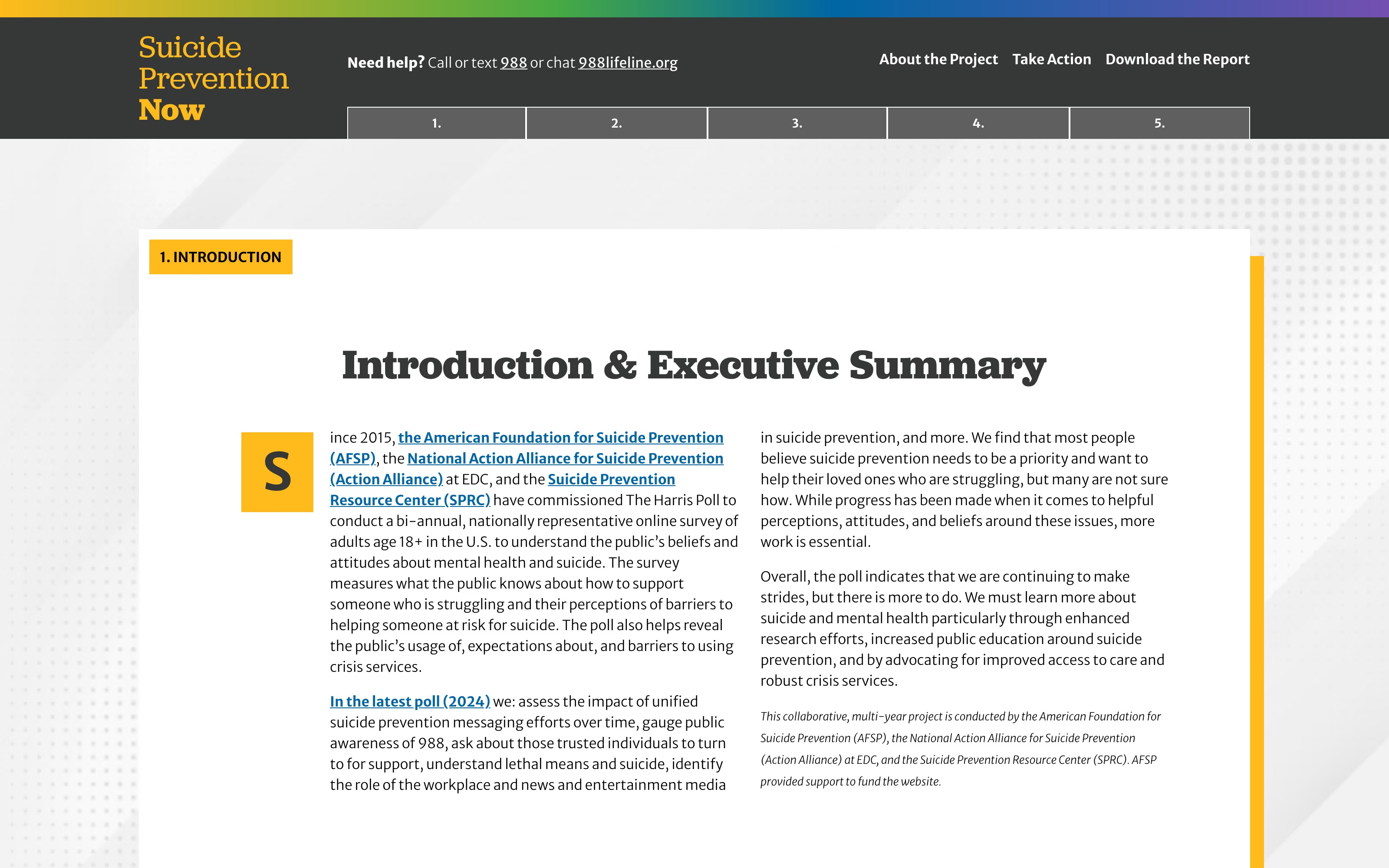
- Four chapters, sequenced from data to action. Introduction, Learn About the Data, Know How to Help, and Advocate for Change. The order teaches: the findings, then what they mean for helping someone directly, then systemic advocacy. It serves the professional evaluating the research and the advocate translating it, without splitting into two sites.
- Tabs over a scroll, so no one is trapped in the sequence. The structure reads like an eBook with clear progression, and the tab navigation lets a reader go straight to the chapter they came for.
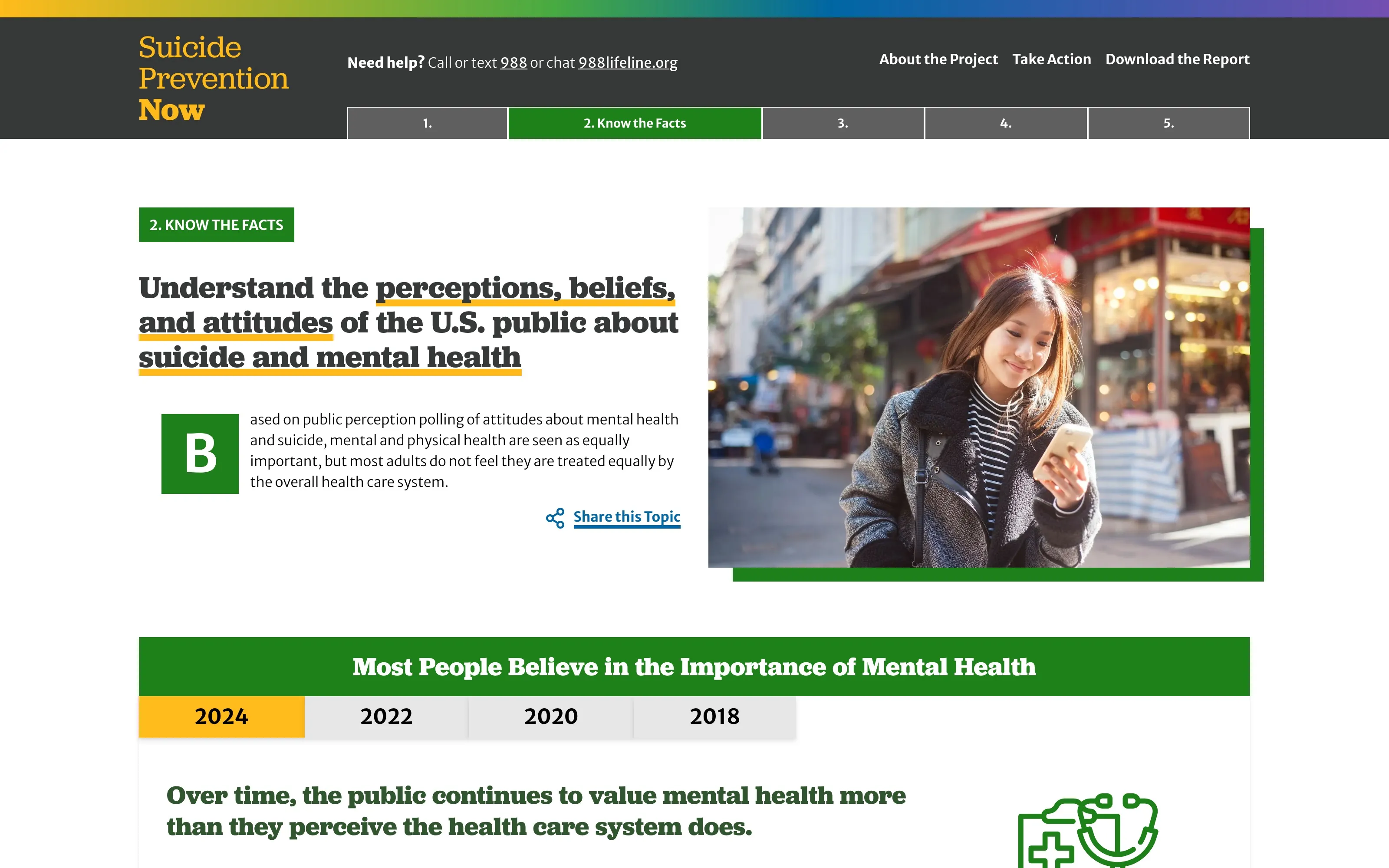
- The same pattern in every chapter. An introduction, the Harris Poll data, routes to resources related to that chapter, and shareable assets for spreading the message through a reader’s own channels. The progression builds toward doing something rather than toward the end of the page.
- Color-coded chapters under one gradient. Each section has its own identity while the navigation gradient ties the four together — distinct content, continuous message. Credibility comes from the three named sponsoring organizations, the Harris Poll methodology and the structure of the presentation itself.
Where it stands
- Two awards. An American Graphic Design Award (GDUSA, Designing for Good, 2022) and a Digital Health Award (Silver, Web-based Digital Health Microsite, 2023).
- It outlived the cycle it was built for. The microsite was commissioned for the 2022 research. It is still the public face of the work, presenting the 2024 poll today, and the data panels put 2024, 2022, 2020 and 2018 side by side — a longitudinal view the original brief never asked for and the structure absorbed anyway.
- And it grew a chapter. The four chapters are five today: Understanding Cultural Nuances was added between helping and advocacy. An architecture that takes a new chapter and two further research cycles without a rebuild is the outcome worth reporting here.
News & Recognition
- May 2023
Suicide Prevention Now wins a Digital Health Award
Silver in Web-based Digital Health Microsite, for a campaign platform built for the American Foundation for Suicide Prevention.
- November 2022
Suicide Prevention Now is named a Best Of Year by Graphic Design USA
An American Graphic Design Award in the Designing For Good category, for a campaign platform built for the American Foundation for Suicide Prevention.
Nonprofit research communication questions
How do you turn survey research into a website people use?
Structure it as learning, not as a report. Suicide Prevention Now presents biennial Harris Poll research as an e-learning microsite: chapters sequenced from the findings to direct intervention to systemic advocacy, each with the data, routes to resources and shareable assets — so the reader ends ready to do something rather than at the end of a page.
Who should a research communication site be designed for?
Ask before designing — the answer moved the American Foundation for Suicide Prevention’s research platform. The initial direction was stylized and playful for a broad public; stakeholder conversations clarified the primary audience as academic and administrative professionals in prevention, policy and public health. The register moved to match them, and that pivot is the decision the rest of the build follows from.
How should a suicide prevention website handle a reader in crisis?
Before the research, on every page. The 988 crisis line sits in the header of every chapter of Suicide Prevention Now, ahead of the data — clear without being clinical, supportive without being prescriptive, for readers who may be practitioners, supporters or struggling themselves.
What makes a microsite last beyond its launch cycle?
An architecture that absorbs growth. Built in twelve weeks for the 2022 research, Suicide Prevention Now presents the 2024 poll today with data panels putting four survey years side by side, and its four chapters have grown to five — no rebuild required. It also took a GDUSA American Graphic Design Award and a Digital Health Awards Silver.
Client leadership

Matthew O’Bryant
Matthew O’Bryant has led platforms for public health and prevention organizations, where the data has to reach practitioners who will act on it.