
Bringing 280 Destinations Into One Venue Search: An Olympic Training Platform for the LA28 Olympic and Paralympic Games
Before the 2028 Games, every national delegation has the same question: where in California will our athletes train, meet and stage? Visit California, in collaboration with LA28, needed the answer to be a product — not a PDF.
The work
The Challenge: Every Delegation Asks Where to Train, and the Knowledge Sat With 280 Organizations
When the Games come to Los Angeles in 2028, the training comes years earlier — national delegations from around the world scouting California for the pools, tracks, high-performance facilities and meeting venues where they’ll base themselves before competition. Visit California, in collaboration with LA28, needed that scouting to have a front door: a statewide hub where a federation can search venues the way a performance director thinks, and where the knowledge — spread across some 280 local destination organizations — flows in from the people who actually have it. The engagement was a product build on a broadcast deadline: a working MVP in seven weeks, then a platform that could grow to hundreds of venues without a central team doing the typing.
The Strategy: A Small, Fast Product With a Self-Sustaining Content Model
Build a small, fast product with a self-sustaining content model.
- A stack sized to the job. Payload CMS, a Next.js front end, Algolia search and Mapbox maps — a seven-week MVP first, a platform second.
- Facets a delegation actually uses. Sport, fields of play, research and recovery amenities, accommodations — and distance to the Athletes’ Village as a filter.
- DMOs as the authors. Domain-validated self-service accounts, scoped to each organization’s own listings, with bulk upload to seed the catalog.
- Built to be exported. Printable venue pages, dialable numbers, prefilled email — outputs for people assembling a packet.
- Monitored weekly, with automated performance and accessibility runs across every template.
The Outcomes: The State’s Answer Is a Product Now
The state’s answer to “where do we train?” is a product now.
- Growth | Hundreds of venues published within months of opening to destination organizations, maintained by the DMOs themselves | A training-facility search within 200 miles of the Athletes’ Village returned 62 candidates when the site was checked in August 2026
- Intelligence | Searches, map use and exports all measured, with venue data structured for the questions delegations ask | Accessibility and best-practices scores of 100 on every weekly performance run since monitoring began

The detail
Why it mattered
- Every delegation asks the same questions. Ahead of the 2028 Games, national Olympic and Paralympic committees, sport federations and commercial partners all need pre-Games bases in California — pools, tracks, gyms, meeting space and somewhere to put a hundred people. California had no statewide venue directory to point them to.
- The knowledge lived in 280 destination organizations. The venues belong to cities and regions, and the people who know them are California’s destination marketing organizations. A statewide hub is only as good as its ability to let those organizations contribute — and keep contributing — without a central team retyping everything.
- A seven-week window to be real. The program needed a working platform in weeks — an MVP fast enough to put in front of stakeholders while the venue data was still being gathered.
- The audience is global and unforgiving. Delegations browse from anywhere in the world, often on the venue floor, and a resource bearing the state’s name alongside the Games had to meet accessibility and performance standards worth monitoring weekly.
The call and the build
- A product stack, sized to the job. Payload CMS for structured venue content, a Next.js front end, Algolia for search and Mapbox for the map — deployed on managed infrastructure with automated tests gating every dependency update. A seven-week MVP proved the concept; the platform grew from there.
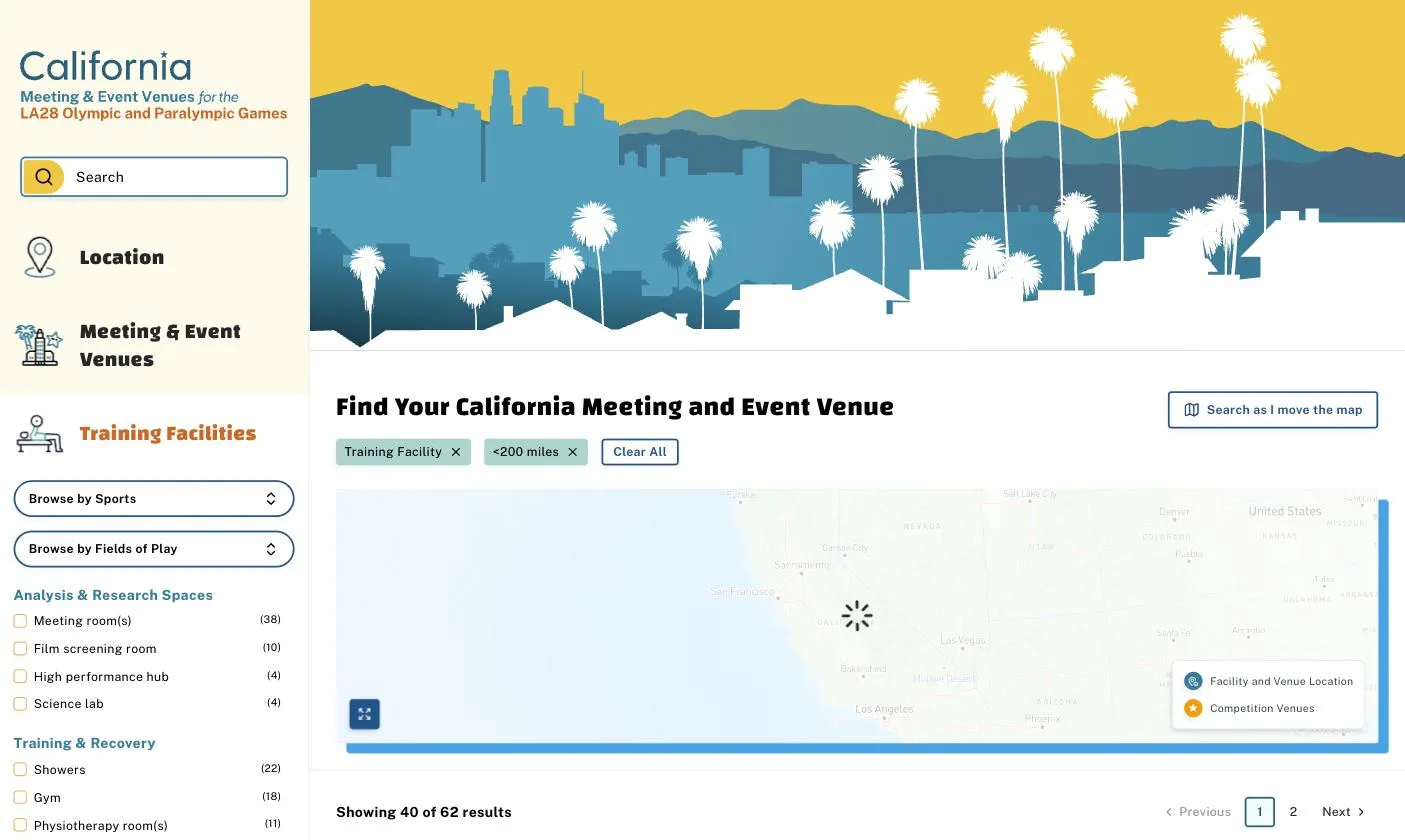
- Search built the way delegations think. Faceted search by sport, fields of play, analysis and research spaces, recovery amenities and accommodations — including a filter for distance to the Athletes’ Village — with results tied to an interactive map that separates candidate facilities from official competition venues.
- The DMOs write it themselves. Destination organizations sign up with domain-validated accounts and manage their own listings — draft, preview, publish — scoped so each sees only its own. A bulk uploader seeded meeting venues from spreadsheets, and the state’s official competition venues live as their own curated collection.
- Export is a feature, not an afterthought. A venue page prints to a clean document, phone numbers dial, and addresses prefill an email — because the person scouting venues is usually assembling a packet for someone else.
- Measured like it matters. Analytics events cover searches, map use and exports; weekly automated performance runs track every template, where accessibility and best-practices scores have stayed at 100 on every recorded run.
What moved
- The hub is live, statewide and self-sustaining. Destination organizations across California maintain their own listings through the gated CMS — the contribution model working as designed, with hundreds of venues published within months of opening to DMOs.
- A search a delegation can act on. A training-facility search within 200 miles of the Athletes’ Village returned 62 candidates when the site was checked in August 2026, each with the amenities, fields of play and export-ready detail a scouting packet needs.
- Standards kept after launch. Accessibility and best-practices scores of 100 on every weekly performance run since monitoring began — the kind of consistency a hub bearing the state’s name alongside the Games has to keep.
- The engagement continues. The platform moved from build into a standing maintenance and enhancement relationship, with stakeholder-driven refinements shipping through 2026.
Venue search platform questions
What do Olympic delegations look for in a training base?
Pools, tracks, gyms, meeting space and somewhere to put a hundred people — searched the way a performance director thinks. Visit California’s venue hub facets cover sport, fields of play, analysis and research spaces, recovery amenities and accommodations, with distance to the Athletes’ Village as a filter and a map separating candidate facilities from official competition venues.
How does a statewide venue hub stay current?
By letting the people who know the venues write it. California’s destination marketing organizations sign up with domain-validated accounts and manage their own listings — draft, preview, publish — with each account seeing only its own. Hundreds of venues were published within months of opening to DMOs, with no central team retyping anything.
How fast can a venue search platform launch?
Visit California’s Olympic venue search platform had a working MVP in seven weeks — Payload CMS for structured venue content, a Next.js front end, Algolia search and Mapbox maps — fast enough to put in front of stakeholders while the venue data was still being gathered, with the platform growing from there.
What makes a venue search platform successful?
For the Visit California build by Pare & Co: a live statewide hub where a training-facility search within 200 miles of the Athletes’ Village returns 62 candidates, listings maintained by the destination organizations themselves, export-ready venue pages for scouting packets — and accessibility and best-practices scores of 100 on every weekly performance run since monitoring began.
Client leadership

Jack Hartman
Jack Hartman’s specialty is cultural and destination platforms. He has led work that puts hundreds of destination organizations behind a single search.