
Publishing Straight From the System of Record: A Product Website for Precision Digital
ExDirect sells explosion-proof instrument enclosures into industrial process plants, and almost everything about that business already lived in Salesforce. We made the website read straight from it, with no second system to reconcile.

The work
“Given the special integration requirements with SalesForce, this has been an interesting project to work on. Most of the site’s internal operations happen on SalesForce, and the site only interacts with a subset of that data.”
The Challenge: A Second Source of Truth Would Have Been a Liability
ExDirect sells explosion-proof instrument enclosures, where the buyer is an engineer matching a certification to a hazardous area classification and a wrong specification is not a returns issue — and almost everything about the business already lived in Salesforce, so a CMS beside it would have created a second place for product truth to disagree with itself.
The Strategy: Make the Website Read From the System of Record
Made the website read from the system of record the business already ran on.
- Salesforce as the CMS. A Laravel application front-ends it, syncing only the subset of data the site actually needs.
- The record stays authoritative. The enterprise system remains the one place product truth lives, so no catalog change is ever made twice.
- Identity and commerce in layers. Auth0 for identity, Foxycart later for cart, checkout and payment.
The Outcomes: A Dynamic Catalog With Nothing to Reconcile
A dynamic catalog with no second system to keep in agreement with the first.
- Growth | ExDirect.com launched dynamic, from static HTML | Full commerce added in layers on the same foundation
- Trust | One source of product truth, in the system that already owned it | No reconciliation gap for a specification a customer might act on
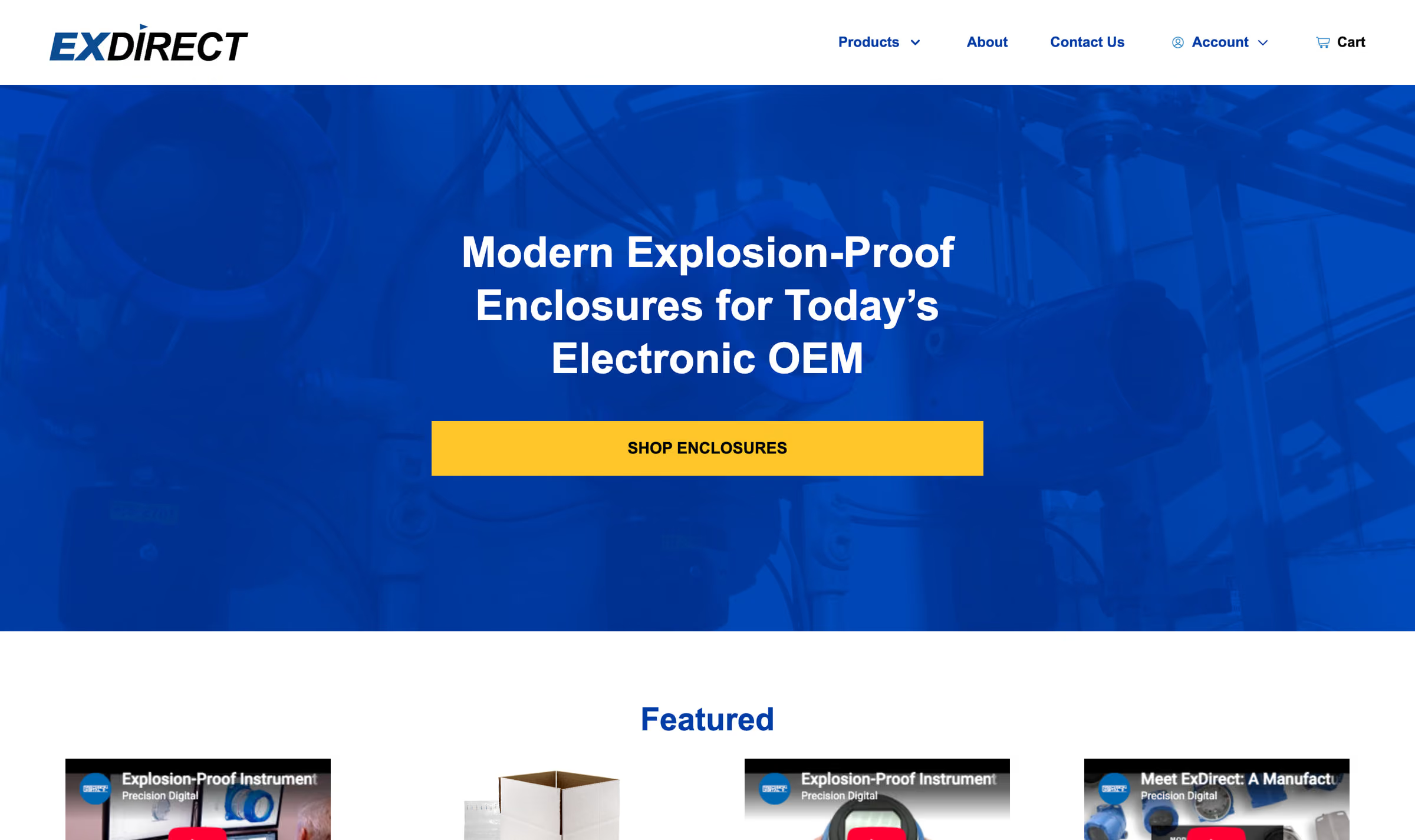
The detail
Why a CMS was the wrong answer
- The specification is a safety boundary. The buyer is an engineer matching a certification and an enclosure rating to a hazardous area classification. Getting it wrong is not a returns issue — that is why a wrong number on a page costs more here than anywhere in commerce.
- Salesforce was already the system of record. Product data, customer records and the commercial reality of the business all lived there and were maintained there. A CMS beside it would have created a second place where product truth was stored.
- A second source of truth is a liability, not a maintenance cost. Every catalog change becomes two changes, and every disagreement between the two becomes a specification a customer might act on.
- The site was static HTML. ExDirect.biz had no dynamic layer at all, so the rebuild’s real question was what to read from.
How it was built
- Salesforce as the content management system. Which is not what Salesforce is for. A Laravel application front-ends it, with integrations synchronizing the subset of Salesforce data the website actually needs into the Laravel database.
- The enterprise system stays the record; the site reads it. The website reads from Salesforce; product truth stays authoritative in one place.
- Identity and commerce added in layers. Auth0 handles identity. Foxycart came later, turning the catalog into a full commerce platform with cart, checkout and payment — on top of the existing foundation.
Why it generalizes
- The pattern is bigger than this engagement. Any manufacturer whose real operating system is a CRM or an ERP faces the same choice, and the default answer — copy the data into a CMS and reconcile forever — is usually the expensive one.
- Salesforce
- Laravel
- Foxycart
- Auth0
Salesforce as a CMS questions
Can Salesforce be used as a CMS?
It can be used as the content source, which is not what Salesforce is for — and that is the interesting part. For ExDirect, a Laravel application front-ends Salesforce, syncing only the subset of data the website actually needs, so the site is a reader of the system of record rather than a rival to it.
Why not put product data in a normal CMS?
Because the data already had a home. ExDirect’s products, customers and commercial reality all lived in Salesforce and were maintained there. A CMS beside it would have made every catalog change two changes — and every disagreement between the two systems a specification a customer might act on.
Why does product data accuracy matter more in industrial commerce?
Because the specification is a safety boundary. The buyer is an engineer matching a certification and an enclosure rating to a hazardous area classification — getting it wrong is not a returns issue, which is why a single source of product truth was the requirement underneath the ExDirect build.
How do you add ecommerce to a Salesforce-integrated site?
In layers. On ExDirect.com, Auth0 handles identity and Foxycart later turned the catalog into a full commerce platform — cart, checkout and payment on top of the existing Salesforce foundation, with no rebuild underneath.
Client leadership

Doug Sisko
Doug Sisko works on customer acquisition and the digital barriers in front of it. He has led catalogue work for manufacturers whose products were hard to find before they were hard to buy.