
Lifting Conversion 40%: A Report Landing Page for RepTrak
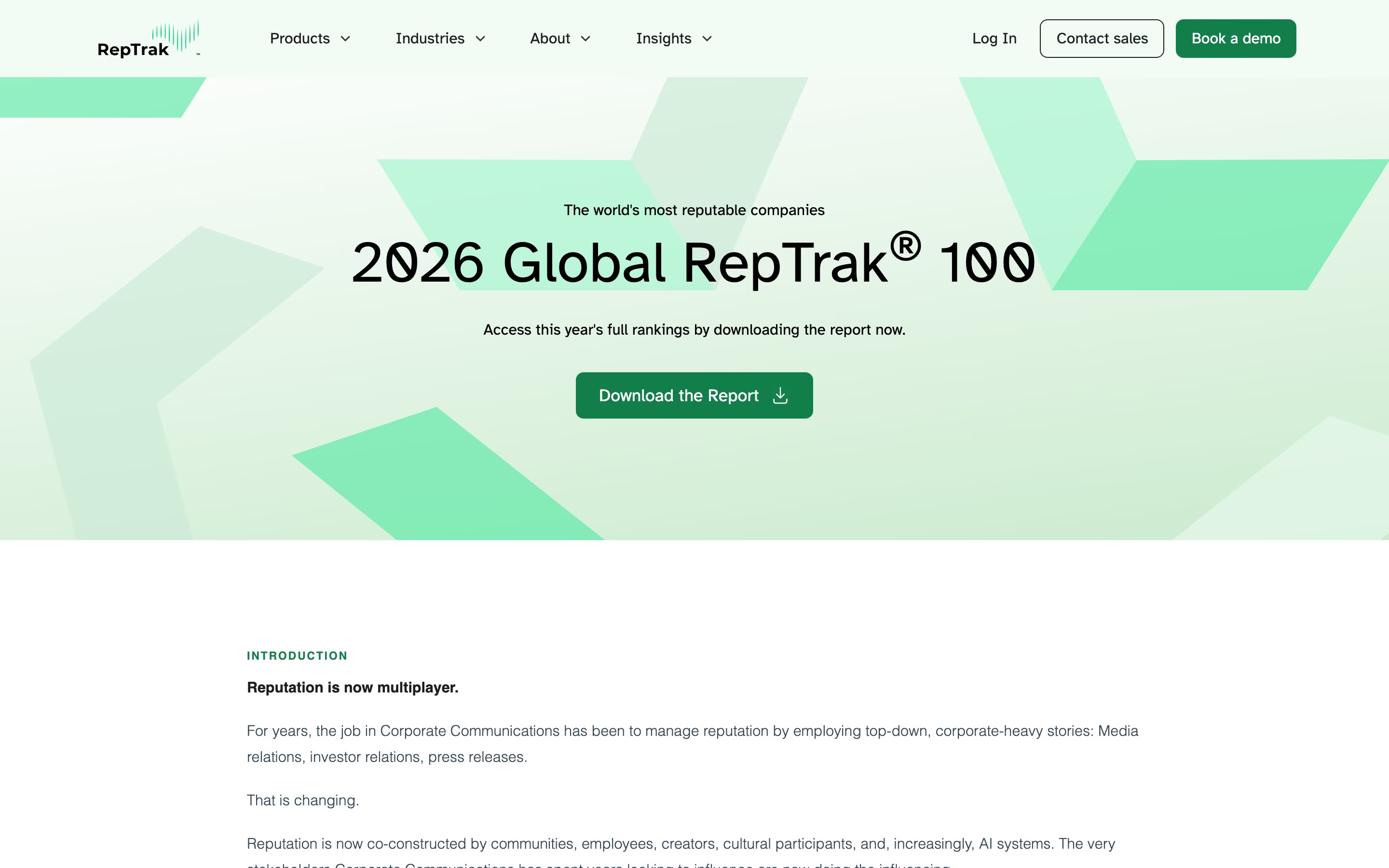
RepTrak’s annual Global RepTrak 100 report is the corporate reputation industry’s definitive ranking — and the company’s top lead generator. We rebuilt the landing page that converts attention into pipeline, and ran 40% better year over year.

The work
“[Pare] truly understood how important this report was to the company and helped us build something that can be translated across our website — so every piece we release can be just as powerful.”
The Challenge: One Landing Page Between an Industry’s Attention and the Pipeline
RepTrak has spent over twenty years building the world’s largest reputation database, and its flagship deliverable — the Global RepTrak 100 — is the closest thing corporate reputation has to the Fortune 500 list. Companies cite it, boards reference it, investor decks include it. For the business it does two jobs at once: the act of publishing the definitive annual ranking is itself a market-leadership claim, and the report is the company’s top lead generator for the year. The landing page hosting it is where attention from an entire industry becomes pipeline — once a year, in a window measured in weeks.
The Strategy: A Landing Page Designed as the Publication It Hosts
Treat the page as the publication it hosts, not as a download form.
- Reframe before redesigning. Scoped as conversion-rate optimization this is a friction hunt; scoped correctly it is a page that has to speak with a category-defining publication’s authority.
- Institutional character as a conversion mechanism, in the hierarchy, the navigation and calls to action that respect the visitor’s intent instead of competing with it.
- Contentful models built for editorial leverage, so the team can keep optimizing between cycles without engineering in the loop.
- A design system scoped past the brief, sized for this cycle and built to keep paying across the wider content surface.
The Outcomes: Conversions Up 40% Year Over Year
The same report, the same season, a page that converts far more of it.
- Growth | Conversions on the redesigned landing page up 40% year over year | Report downloads up 6%
- Engagement | Editorial autonomy in Contentful, so optimization continues between annual cycles | Design system components extending beyond the two pages in scope
The detail
Why it mattered
- The page was working, just not at the level of the asset under it. The team had built and refined these pages over years and the experience was functional. Nothing was broken, which is exactly why nothing raised an alarm — the cost arrived as a conversion rate no one could see was low.
- One cycle a year, and no second chance at it. The report runs once, with a marketing window measured in weeks. Whatever rate the landing page produces is the rate the company lives with for a year. Underperformance there is not a usability issue; it is a missed annual revenue moment that does not come back.
- The page treated the report as content, not as the category-defining moment it was. Visitors arrived with high intent — they came specifically because they had heard about the ranking — and the journey from “I want this report” to “I have it and I am in your funnel” had more friction in it than a top lead-generation surface should.
- The Contentful implementation was not structured around editorial leverage. Content managers needed to update and refresh the landing pages between report cycles, and the existing model required more development support than it should have. Editorial autonomy was constrained by the platform setup rather than supported by it.
- And the design had not kept pace with the market position. Twenty years of accumulated authority in the category, on a digital surface without the institutional weight the brand had earned.
The call and the build
- Reframe the engagement before designing anything. Most landing-page redesigns are scoped as conversion-rate optimization — find friction, remove friction, measure lift. That frame underestimates what was happening here. The Global RepTrak 100 is not a marketing asset that needs better packaging; it is a category-defining publication, and the landing page is where the corporate reputation industry meets RepTrak’s authority claim. The design had to live up to that weight rather than optimize against it.
- Institutional, not transactional — and that choice is itself the mechanism. Visual design, navigation and content hierarchy were built to reinforce RepTrak as the source of record: clear attention to the report’s key insights, calls to action that respected the visitor’s intent rather than competing for it, structure that matched the publication’s category weight. A page that reads like a definitive industry ranking converts better than a page that reads like a content download form.
- Contentful modeling built around the editorial workflow that exists. New content models designed for how the internal team actually works — flexible enough for the iterative optimization high-performing landing pages require, structured enough to keep brand consistency across changes. Content managers got the leverage to keep optimizing after launch, and that is what makes a year two and a year three possible at all.
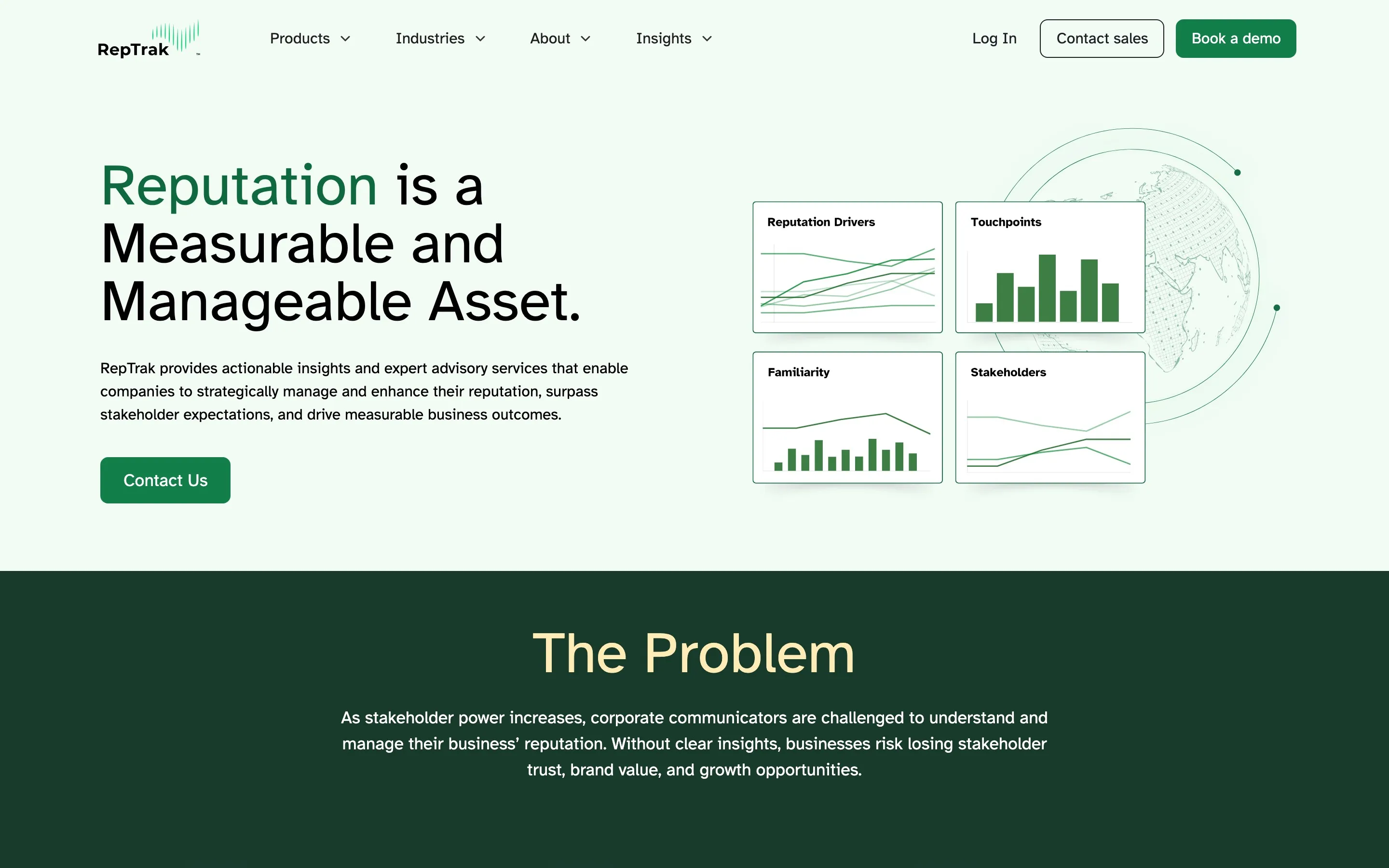
- A design system sized past the two pages in scope. The work delivered components that extend beyond the landing page and the homepage — an investment scoped for the immediate cycle and built to keep paying across the wider content surface, which is the point the client’s own words on this page make.
- An outside perspective, deliberately. The build ran with what the engagement called an impartial confidant role: bringing recommendations the internal team’s own vantage point could not easily generate without falling back into established patterns, and asking what was being missed before assumptions hardened into decisions.
What moved
- Conversions up 40% year over year. On the redesigned landing page, against the previous cycle of the same annual report — the closest thing to a controlled comparison this kind of work gets, with the asset, the audience and the season all unchanged.
- Report downloads up 6%. More people took the report, and a much larger share of the people who arrived completed the journey. The gap between those two numbers is the conversion work rather than the traffic.
- The report has run again since, on the same platform. reptrak.com/rankings/ carries the 2026 Global RepTrak 100 today, with the same single-ask structure. Cycles that come and go without a rebuild are what editorial autonomy looks like from outside.
Landing page conversion questions
How do you increase landing page conversion rates?
Sometimes by refusing the usual frame. Scoped as conversion-rate optimization, a redesign is a friction hunt; RepTrak’s Global RepTrak 100 page was scoped instead as a surface that has to read like the category-defining publication it hosts. A page that reads as a definitive industry ranking converts better than a page that reads as a content download form — and this one converted 40% better year over year.
What makes a B2B report landing page convert?
Authority and a single ask. The rebuilt Global RepTrak 100 page puts the report’s key insights in a hierarchy that matches its category weight, keeps calls to action that respect the visitor’s intent rather than competing for it, and ends in one clear ask. Visitors arrive with high intent — they came for the ranking — so the page’s job is to spend none of it.
How does Contentful help with landing page optimization?
By keeping engineering out of the editorial loop. RepTrak’s content models were rebuilt around how the internal team actually works: flexible enough for the iterative optimization high-performing landing pages require, structured enough to keep brand consistency across changes, so the team keeps optimizing between annual report cycles.
How much can a landing page redesign move conversion?
For the RepTrak rebuild by Pare & Co: conversions up 40% year over year on the redesigned Global RepTrak 100 page and report downloads up 6% — measured against the previous cycle of the same annual report, the closest thing to a controlled comparison this work gets, with the asset, the audience and the season all unchanged.
Client leadership

Doug Sisko
Doug Sisko’s specialty is growth and conversion strategy. Landing page and conversion work for B2B software is the most direct form of it.