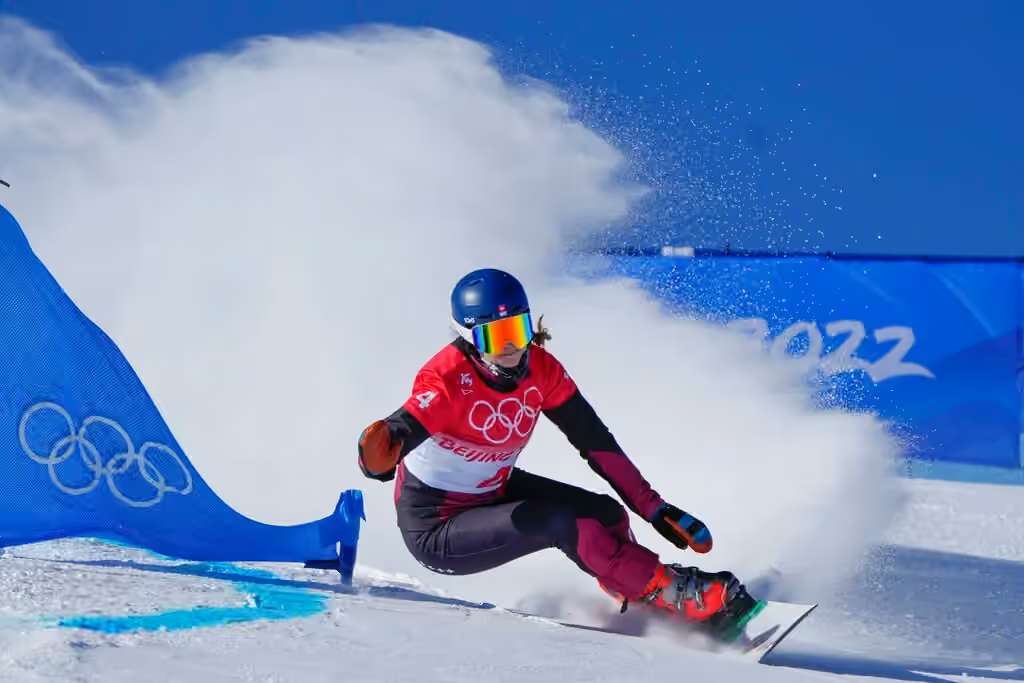
Powering 200 Affiliates Through One Olympics: Coverage Infrastructure for NBC Sports
NBC Sports needed to coordinate Olympic coverage across more than 200 local affiliate stations during a media event with no margin for editorial drift. We built the platform that lets the network operate as one editorial entity — and lets NBC keep its standards intact while it scales.

The work
The Challenge: Hundreds of Olympic Stories and No Pipeline to Run Them Through
Olympic coverage is not one feed. It is hundreds of stories — athlete profiles, hometown angles, regional features, market-specific reaction — produced across dozens of timezones under two weeks of deadline pressure by 200+ local affiliate stations, every one of which has to clear NBC’s marquee editorial standards before air. At that volume, friction in submission and approval does not make a story late. It makes a story not exist.
The Strategy: The Olympic Zone, One Editorial Hub for a Federated Network
Built the Olympic Zone: editorial infrastructure that lets a federated network operate as one editorial entity for the length of a high-stakes event, on Drupal.
- One submission flow for every kind of contribution. Articles, athlete spotlights, polls, galleries and ad campaigns enter the same way, and one flow is what makes the queue visible and countable.
- Multi-step review with the gates built in. Each submission routes through the right NBC editorial layer, with automated notification at every step and role-based permissions that cannot be shortcut.
- A hub rather than a CMS. Submission, review, governance and shared resources in one place, built around how broadcast affiliate coordination actually works.
The Outcomes: 200+ Stations Submitting Through One Flow
A pipeline NBC’s editors could see, and standards enforced by the system rather than by 200 local interpretations.
- Engagement | 200+ affiliate stations submitting through one standardized flow | A queue editors could manage at the velocity the Games demand, rather than a set of one-off coordination problems
- Trust | Multi-step review with role-based permissions, so the editorial gates cannot be walked around | NBC’s rights and compliance environment kept in the workflow, not left to local interpretation
The detail
Why it mattered
- The submission pipeline was invisible. Affiliate stations submitting hundreds of Olympic stories had no standard pathway from draft to NBC review to approval, so every submission was its own coordination problem. Editors could not see what was queued, what was in review or what was approaching approval at any given moment — which makes a pipeline impossible to manage at velocity.
- Editorial standards were being enforced 200 different ways. NBC’s standards exist to protect the brand and to meet the rights and compliance environment around Olympic content. Enforcing them consistently across 200+ submitting parties, each working from its own local editorial culture, needs a system that bakes the standard into the workflow. Without one, quality and compliance are uneven by definition.
- There was no shared place to get the assets from. Affiliates needed NBC’s graphics, video, training material, editorial guidelines and pre-packaged content to produce coverage that fit the network’s system. Email and shared drives do not scale to 200+ recipients on Olympic deadlines, so affiliates either worked from stale assets or made their own — and both outcomes break the coordinated coverage the network is trying to produce.
- The failure mode is not a late story. Under Olympic conditions, friction in submission and approval does not delay coverage. It removes it. The volume is at peak, the timeline is unforgiving, and the audience is the largest the network sees outside major scheduled programming.
How it was built
- Not a CMS. Editorial infrastructure for a federated network. The platform was purpose-built around the operational realities of broadcast affiliate coordination during a high-volume event: one submission, review, governance and resource hub for Olympic coverage across every participating affiliate.
- One submission flow for every kind of contribution. Articles, athlete spotlights, polls, media galleries and ad campaigns all enter through the same standardized flow, and one flow is what makes the queue countable.
- Multi-step review, with the gates built in. Each submission routes through the appropriate NBC editorial layer before approval. Automated notifications walk every participant through submission, review action, approval and publication, and role-based permissions restrict publishing to authorized users so the gates cannot be walked around by user error or workflow shortcut.
- One place to get the assets from. The Olympic Zone doubles as the network’s resource hub: training materials and editorial guidelines for covering the Games, Olympic-themed graphics, video and pre-packaged content, with an integrated digital asset and video management system handling encoding, processing and rights management.
- Profiles and channels, so coordination has an address. Stations keep detailed profiles — contacts, market details, associated satellite stations — and direct channels connect NBC’s editorial team to local teams, so the conversation about a story lives next to the story.
Why the infrastructure had to catch up
- The institution had outgrown its coordination model. Distributed editorial networks without purpose-built infrastructure default to ad hoc coordination — email, file transfer, phone approvals, scattered review threads, manually tracked permissions. That works for routine coverage and breaks at Olympic scale.
- Every cycle, the gap got papered over with hours. Extra editorial staffing and ad hoc workflow management closed the distance each time. The Games were going to keep happening.
Editorial workflow platform questions
How do you manage editorial workflow across hundreds of contributors?
One standardized flow, whatever the contribution. On NBC’s Olympic Zone, articles, athlete spotlights, polls, media galleries and ad campaigns all enter the same way — and one flow is what makes the queue visible and countable — with automated notifications at submission, review, approval and publication, so no story’s status lives in anyone’s inbox.
How does a broadcast network keep editorial standards at scale?
By building the gates into the system instead of enforcing them 200 different ways. Every Olympic Zone submission routes through the appropriate NBC editorial layer before approval, and role-based permissions restrict publishing to authorized users — so the standards protecting the brand and the rights environment cannot be walked around by user error or workflow shortcut.
How should shared media assets reach affiliate stations?
Through one hub rather than email and shared drives, which do not scale to 200+ recipients on Olympic deadlines. The Olympic Zone centralizes training materials, editorial guidelines, graphics, video and pre-packaged content, with an integrated digital asset and video management system for encoding, processing and rights management.
What does purpose-built editorial infrastructure change at scale?
For NBC Sports’ Olympic Zone by Pare & Co: 200+ affiliate stations submitting and distributing Olympic stories through one flow, approval bottlenecks reduced, curated Olympic content in every market’s hands, and secure infrastructure that stood up to Olympic traffic volumes — with the network’s standards enforced by the workflow rather than by 200 local interpretations.
Client leadership

Jack Hartman
Jack Hartman’s specialty is editorial operations. He has led publishing infrastructure built for the weeks when the audience arrives all at once.