
Publishing at the Speed of the Science: A Content Platform for Foundation Medicine
Foundation Medicine’s editorial team had lost the ability to keep pace with their own field. The platform was the reason.

The work
The Challenge: A Decoupled CMS Slowing a Field That Moves Weekly
Foundation Medicine, a subsidiary of Roche, tells oncologists, researchers and patients what the genomic mutations driving a cancer actually mean — a field where a therapy clears approval or a guideline shifts most weeks. Its platform ran on a decoupled architecture whose headless content layer had multiplied into 158 content types, and routine updates were taking the editorial team weeks to ship.
The Strategy: Moving From Headless Back to a Coupled CMS
Re-platformed onto Drupal, a coupled CMS, because coupling is the feature for a team whose need is publishing speed and accurate preview on a single main surface.
- 158 content types became 30. Fourteen covering the real editorial domain and sixteen design components that compose into everything else, replacing a dedicated type for every layout variation.
- The clinical tools moved intact. The DNA explorer, specialist finder and resource navigator were migrated rather than rebuilt, then brought under the same governance as the rest of the site.
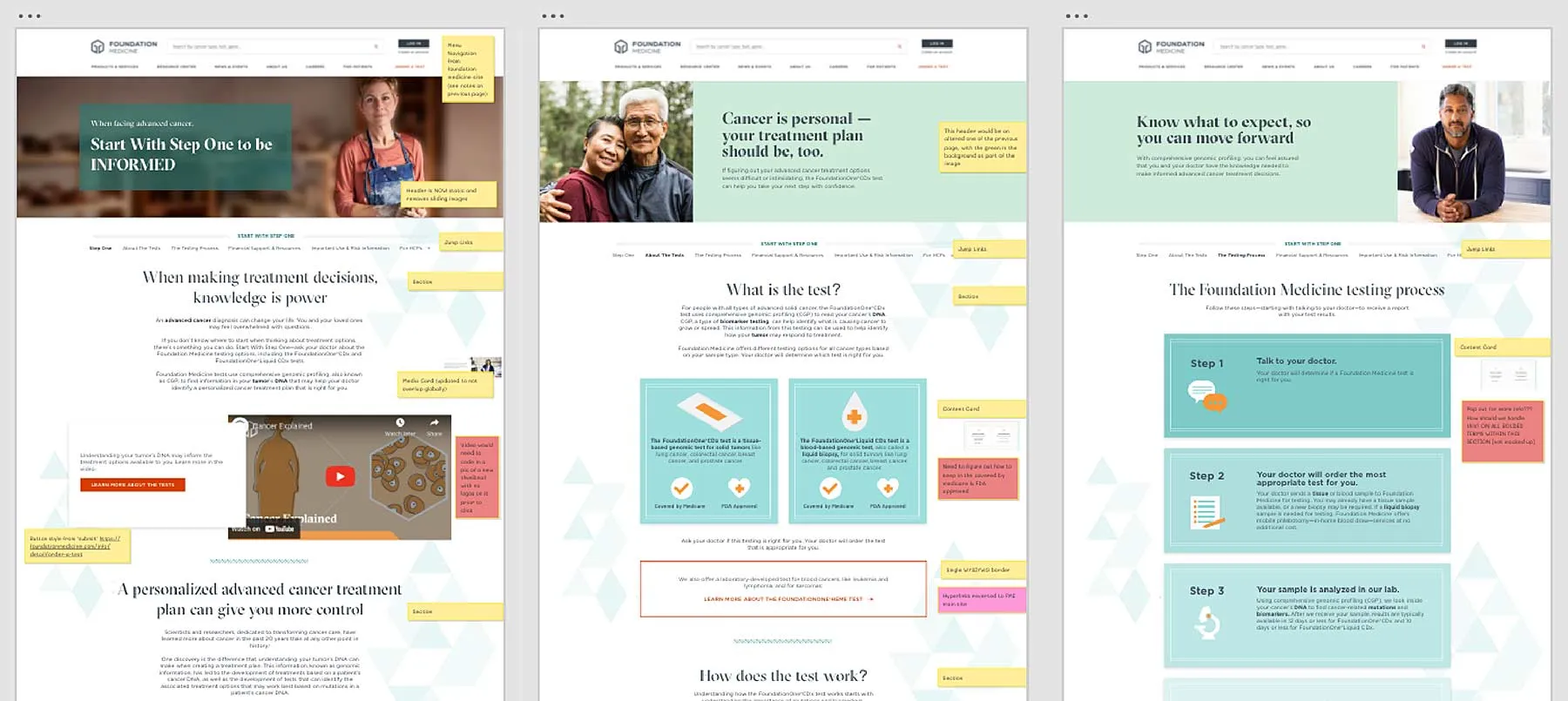
- The design stayed exactly where it was. It was performing, so the re-platform happened underneath it.
The Outcomes: Draft to Live in One Session, Page Views Up 11.7%
A team responsible for putting current cancer information in front of the people who need it can do that at the speed the work demands.
- Intelligence | 158 content types collapsed to 30 | Draft to live in one working session instead of three
- Engagement | +11.7% page views | +45% scroll depth, +16% engagement
- Trust | Clinical tools migrated with every behavior and accessibility commitment intact | The bottleneck is the team again, not the platform
The detail
Why it mattered
- The platform was a recent investment, and the wrong fit. A decoupled architecture with a headless content layer and custom front ends is a defensible choice for organizations with several surfaces, heavy personalization or product teams shipping UI independently of editorial. None of those described Foundation Medicine.
- 158 content types. The headless layer treats nearly everything as a content type, so authors hunted through endless lists to find the page they needed to edit.
- Front-end copy lived in templates, not the CMS. Adding it would have meant still more content types, so the team waited on engineers to change plain text.
- No accurate preview. Authors composed in the admin, published, looked at the rendered page, then went back to fix what had not come out as expected. Every editorial action ran through that loop.
The call
- Coupled over decoupled is a fit judgment, not a quality one. Recommending a monolithic CMS runs against the direction most procurement decks are heading. But for a team whose need is publishing speed, accurate preview and editorial autonomy on one main surface, coupling is the feature: the CMS knows the page, the page knows the CMS, and the author sees what the reader will see.
- Redesign the model, do not reproduce it. A structural audit of every page, component and content type found the same pattern throughout — a dedicated type for every minor variation in layout or context. General-purpose components with optional configuration collapsed most of that surface area without losing expressiveness.
- Migrate the clinical tools, do not rebuild them. The cancer DNA explorer, the specialist finder and the provider-facing resource navigator represent years of clinical product investment. Every behavior, integration and accessibility commitment was preserved, then made governable from the same CMS as everything else.
- Leave the design alone. The brand and front-end design were performing and were never in scope. The work happened underneath them, so everything a reader sees stayed where it was.
What changed
- The editorial team owns publishing again. Text edits take minutes instead of tickets, pages preview accurately, and content moves from draft to live in a single working session instead of three.
- The bottleneck moved back to the people. When a clinical update breaks, the constraint is how fast the team can write it, not how long the platform takes to accept it.
CMS replatforming questions
When is a headless CMS the wrong choice?
When the organization has one main surface and its bottleneck is editorial. Headless earns its complexity for teams with several surfaces, heavy personalization or product teams shipping UI independently of editorial. For a team whose need is publishing speed, accurate preview and autonomy on one website — Foundation Medicine’s case — coupling is the feature: the CMS knows the page, the page knows the CMS, and the author sees what the reader will see.
How do you reduce content types in a CMS migration?
Audit first, then generalize. A structural audit of every Foundation Medicine page and component found the same pattern throughout — a dedicated type for every minor layout variation — and 158 content types became 30: fourteen covering the real editorial domain and sixteen general-purpose design components that compose into everything else.
Can you replatform a website without redesigning it?
Yes, and sometimes you should. Foundation Medicine’s brand and front-end design were performing, so the replatform happened underneath them — invisible by design. The clinical tools moved intact too, every behavior and accessibility commitment preserved, then brought under the same governance as the rest of the site.
What are the benefits of moving off a headless CMS?
For the Foundation Medicine rebuild by Pare & Co: text edits in minutes instead of tickets, content moving from draft to live in one working session instead of three, and the audience metrics moving with it — page views up 11.7%, scroll depth up 45% and engagement up 16% — with the bottleneck returned to how fast the team can write, not how long the platform takes to accept it.
Client leadership

Matthew O’Bryant
Matthew O’Bryant’s specialty is regulated content operations — publishing that has to move at the pace of a field and survive review anyway.