
Bringing a Policy Practice Into the Open: A Practitioner Playbook for The Policy Lab at Brown University
The Lab Manual exists to help government officials apply scientific research to public policy — by giving them a working guide to setting up policy labs, collaborating with researchers and using evidence-based methods. We built the platform that delivers it: an interactive resource that makes complex research approachable, with the operational simplicity to keep growing as the field evolves.

The work
The Challenge: The Field’s Answers Lived in One-Off Conversations
A city manager or state agency director who wants to apply evidence-based methods to their work usually does not know how to start, and the questions they need answered — how to set up a policy lab, how to work with academic researchers, how to design a randomized evaluation, how to judge whether a paper’s findings apply to their context — are not taught in any depth by public administration programs. The answers existed, scattered across academic journals, foundation white papers and one-off conversations between practitioners, in formats written for everyone except the person reading on a tight schedule.
The Strategy: A Guided Journey, Built Custom and Kept Simple
Since nothing quite like The Lab Manual existed, discovery looked beyond government and research sites entirely — to data-rich experiences like FiveThirtyEight and e-reader apps like Kindle — and the build turned what came back into a site that reads as a guided journey.
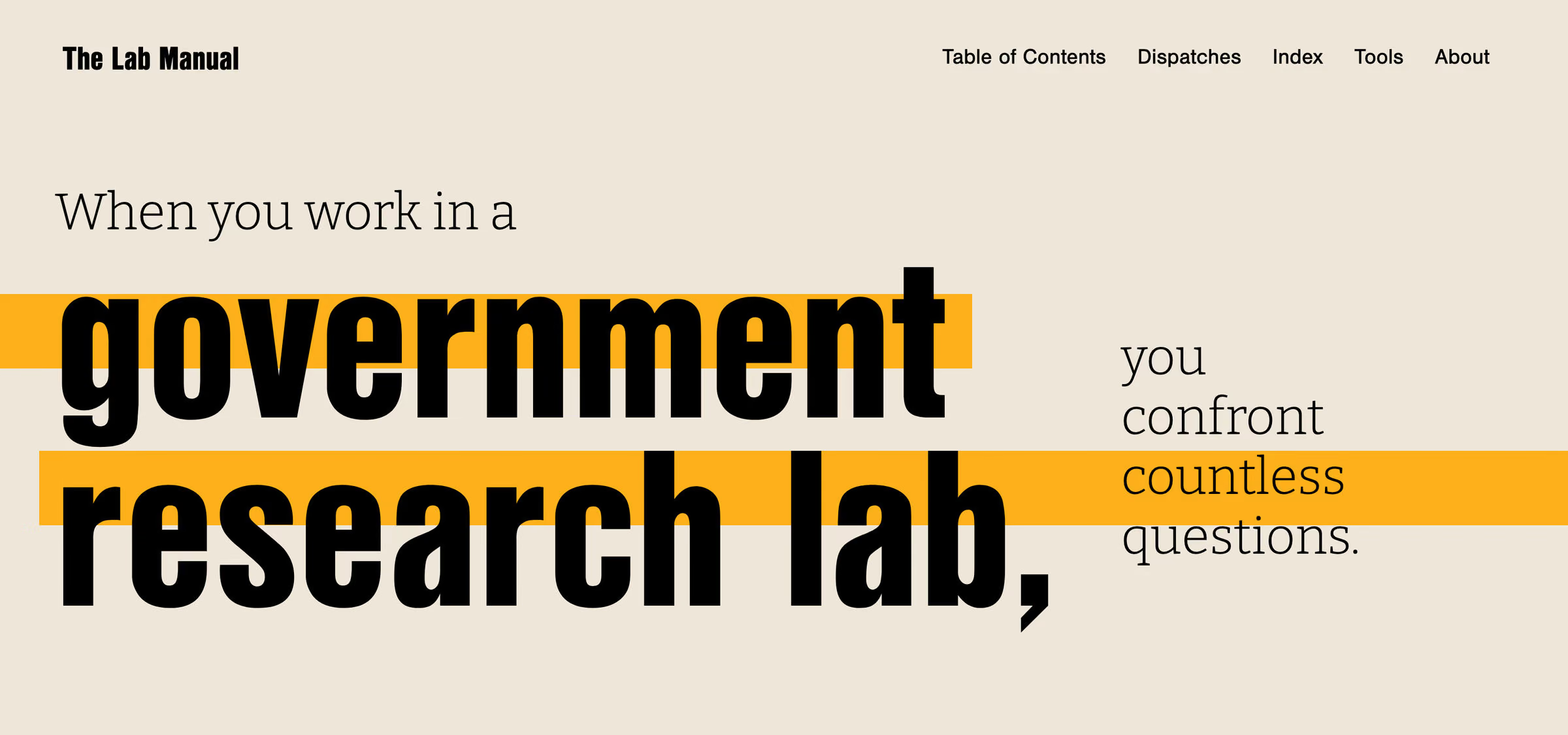
- A narrative-driven homepage. The manual’s story told with animated elements, mocked up in motion directly in Figma so the client approved the experience before development began.
- Educational features that keep the reader in the story. A linked glossary that expands terms in place, a pop-up search where footnotes would have been and a Mapbox map for finding nearby policy labs.
- A CMS-less build edited in Markdown. No platform license and no upgrade cycle, so the resource keeps growing on a foundation grant budget — comprehensive in what it delivers, lightweight in what it costs to run.
The Outcomes: A Working Guide With the Tools Attached
A working guide rather than a literature review — recognized with a Graphic Design USA American Digital Design Award, and built to keep growing as the field does.
- Trust | Guidance grounded in the practice of people who have built policy labs, collected in one place instead of one conversation at a time | Templates, forms and resources downloadable individually or a module at a time
- Engagement | Five ways in — read it through, look something up, see what is new, take something away, find out who is behind it | The field’s growth no longer capped by the calendars of a few experts
The detail
Why it mattered
- The answers existed in one-off conversations. A practitioner asking how to set up a policy lab would get a thoughtful, specific answer from someone who had done it — and that answer existed only in that conversation, connected to nothing else, and could not scale to the number of practitioners becoming interested in the field.
- The audience was growing faster than mentorship could serve it. Interest in evidence-based policy among government practitioners expanded substantially; the supply of people who could explain how to build the capability did not. Without scalable infrastructure, the field’s growth is capped by the calendars of a small number of experts.
- The resources existed but were not connected. Setting up a policy lab means understanding organizational structure, hiring, partnership agreements, evaluation methodology, ethical review, data infrastructure, communication strategy and dozens of other operational dimensions. Each had been written about somewhere — academic literature, foundation reports, government memos, practitioner essays — and the connections between them were surfaced nowhere. Assembling the whole picture was the practitioner’s own unpaid work.
- And the form factor was wrong for the reader. Academic literature is written for academic readers, foundation reports for foundation contexts, government memos for internal government audiences. None of those formats is designed for a practitioner reading on a tight schedule, looking for actionable guidance, needing to translate an idea into work this week.
- The questions are not taught anywhere in depth. How do you set up a policy lab? How do you collaborate with academic researchers? How do you design a randomized evaluation of a program intervention? How do you read a research paper critically and work out whether the findings apply to your policy context? Public administration programs do not answer these.
How it was built
- Inspiration came from outside the sector. Traditional government and research sites could not model what this needed to be. Stakeholder discovery sessions ran alongside a survey of experiences from other industries — data-rich sites like FiveThirtyEight, e-reader apps like Kindle — to find the patterns behind engaging long-form content, strong visual storytelling and interactive data.
- A narrative-driven homepage, mocked up in motion. The homepage tells the manual’s story rather than listing its sections, with animated elements that make the page feel like a guided journey instead of a linear scroll. The animations were mocked up directly in Figma, so the client could see the experience rather than imagine it — and development started from an approved motion design instead of a guess.
- Features that answer questions without interrupting the story. A linked glossary expands key terms in place. A pop-up search covers other terms and topics, where a traditional publication would have parked them in footnotes. A Mapbox map helps visitors find policy labs near them. Each keeps the reader inside the narrative at the moment a question would otherwise have pushed them out of it.
- Comprehensive in what it delivers, lightweight in what it costs to run. A custom, CMS-less build the client edits in Markdown: no platform license, no upgrade cycle, and updates that cost editorial time rather than development time. A resource for a growing field has to keep growing on a foundation grant budget, and the architecture is what makes that budget go the distance.
- An MVP with the phasing decided on purpose. Features that mattered most to the launch audience were prioritized first; future capabilities were planned and deliberately not built into the initial release, so the site launched on the desired timeline and budget.
What it offers now
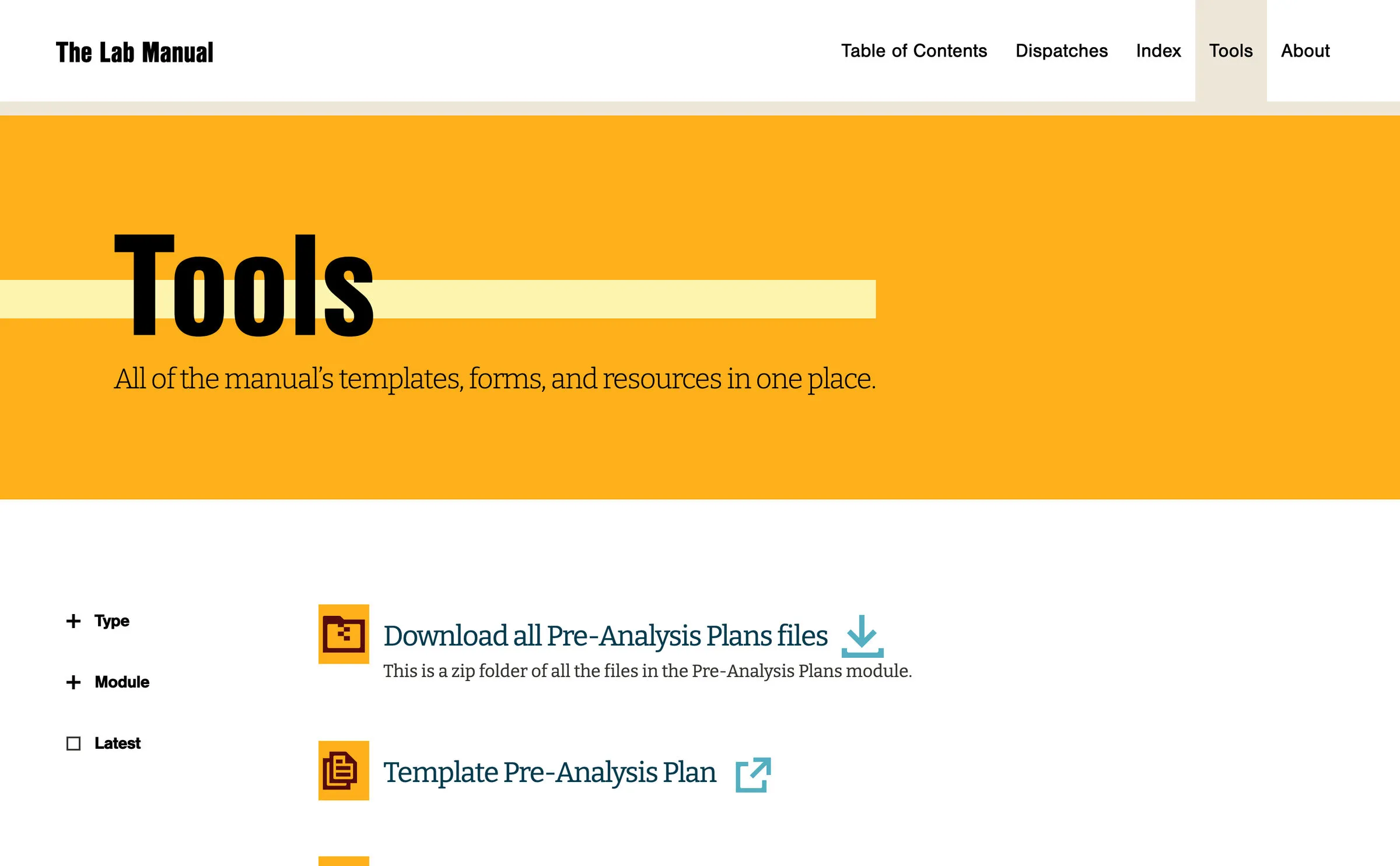
- Five ways in, and each is a different kind of use. Table of Contents for working through it, Index for looking something up, Dispatches for what is new, Tools for taking something away, About for who is behind it.
- The tools are files, not descriptions of files. Templates, forms and resources filtered by type and module, offered individually or as a zip of everything in a module — which is the difference between a resource that explains a pre-analysis plan and one that hands you the template for writing one.
- Recognition from the design industry. The site won a Graphic Design USA American Digital Design Award in 2024 — and for The Lab Manual, the more important win is that a resource which existed as one-off conversations is now infrastructure the whole field can use.
- The premise underneath all of it. Government decisions affect millions of people, and those decisions should be informed by what research has actually established rather than by tradition, intuition or political preference alone. The platform is capacity-building infrastructure for the practitioners who can move that.
- Mapbox
Policy research platform questions
What is a policy lab?
A unit inside a government that applies scientific research to policy decisions — testing program changes with rigorous evaluation, working with academic researchers and building evidence into how the organization decides. The Lab Manual, from The Policy Lab at Brown University, is a working guide to setting one up and running it well.
How do you make academic research approachable on the web?
By designing for the practitioner rather than the literature. Discovery for The Lab Manual looked outside government and research entirely — data-rich sites like FiveThirtyEight, e-reader apps like Kindle — and the build turned what came back into a guided journey: a storytelling homepage, a linked glossary, a pop-up search that answers questions where footnotes would have parked them, and a Mapbox map of nearby policy labs.
Can a content-rich site run without a CMS?
Yes, and sometimes it should. The Lab Manual is a CMS-less build the client edits in Markdown — no platform license, no upgrade cycle, and a cost of ownership a foundation grant can sustain while the resource keeps growing.
How should a new digital platform be scoped for launch?
As an MVP with the phasing decided on purpose. The Lab Manual prioritized what mattered most to the launch audience, planned future capabilities and deliberately left them out of the first release — which is how it launched on the timeline and budget the grant allowed.
How do you scale expert mentorship online?
For The Lab Manual build by Pare & Co: a resource that turned one-off expert conversations into a working guide any practitioner can use, a Tools page whose templates and forms download individually or a module at a time, and a Graphic Design USA American Digital Design Award in the year it shipped.
Client leadership

Matthew O’Bryant
Matthew O’Bryant has led the work that moves a research practice into public view, where the audience is other practitioners rather than a general reader.