Motivating Farmers to Stay With a Harder Method: An Online Learning Platform for Seraphic Group
Regenerative farming reverses soil damage and costs more in the short term than the chemical-heavy alternative. Atlus∗U had to teach it, and then keep people doing it after the first hard season.
The work
The Challenge: Teaching a Method That Costs More Before It Pays Off
At current rates of soil destruction, scientists expect serious public health issues and food shortages within fifty years. That is the route Seraphic Group’s founder, Zach Bush, MD, took into regenerative agriculture: patterns in people’s health that led directly back to the food supply.
Getting a farmer to switch is the hard part. Regenerative farming pays over time and costs more in the near term, in money and in labor, than the conventional approach it replaces. The right techniques depend on geography, soil type and climate, so there is no single method to hand over. Atlus∗U had to teach it, motivate someone to try it and keep them with it through the seasons where the argument is weakest.
The Strategy: An Online Learning Platform Where Retention Is the Design Problem
Treat retention as a design problem rather than a content problem.
- Purpose before features. Atlus∗U spans Student Stakes Learning and Broad Stakes Learning, so the education matters to the learner and to the community around them, and the toolset follows from that.
- Comprehension and motivation together. A farmer who understands the method and abandons it after one season has not been served.
- Content, accountability and community as one framework, with personal stories from farmers who had already converted their own businesses.
The Outcomes: A Community Mobilized Around the Coursework
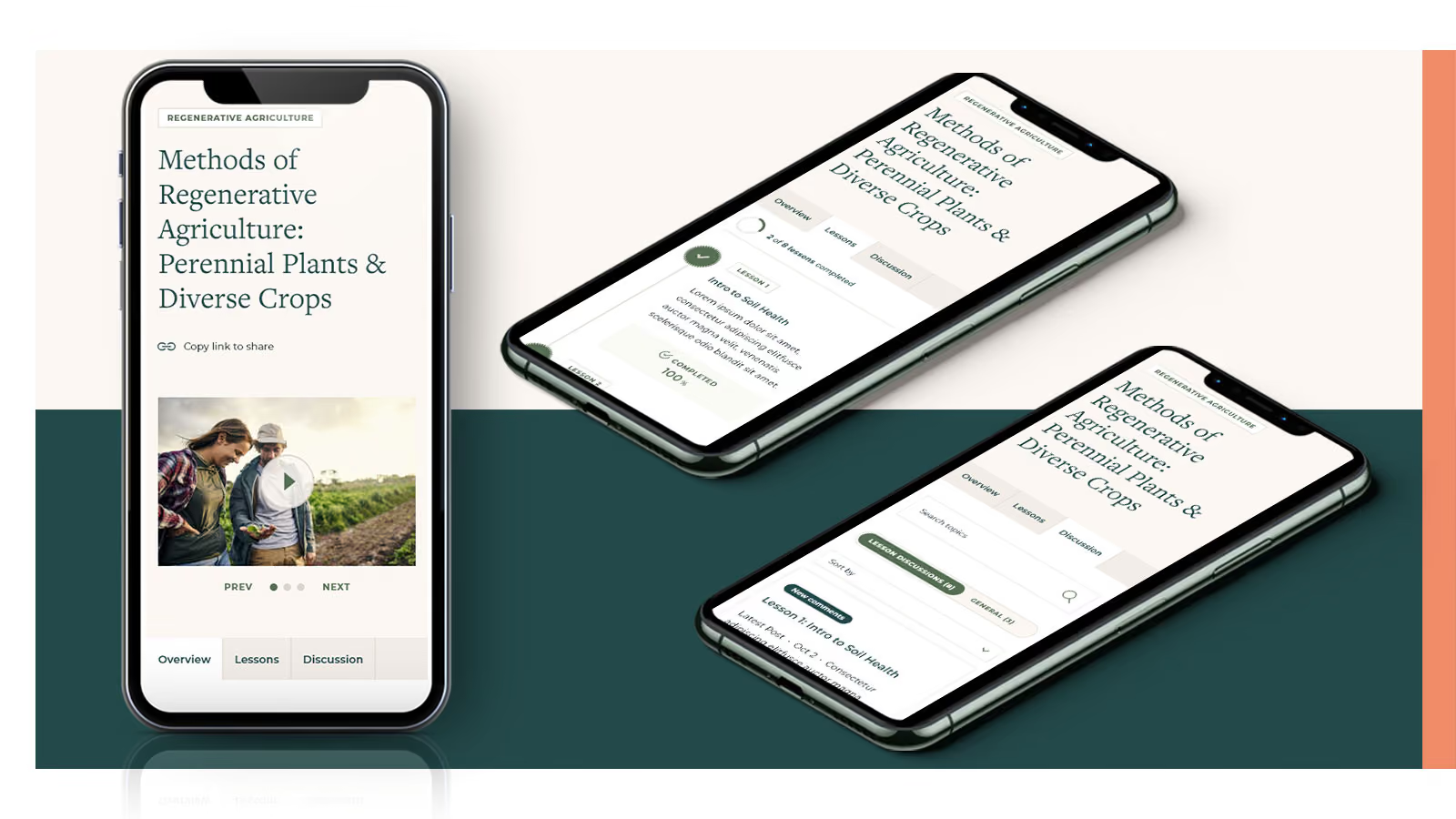
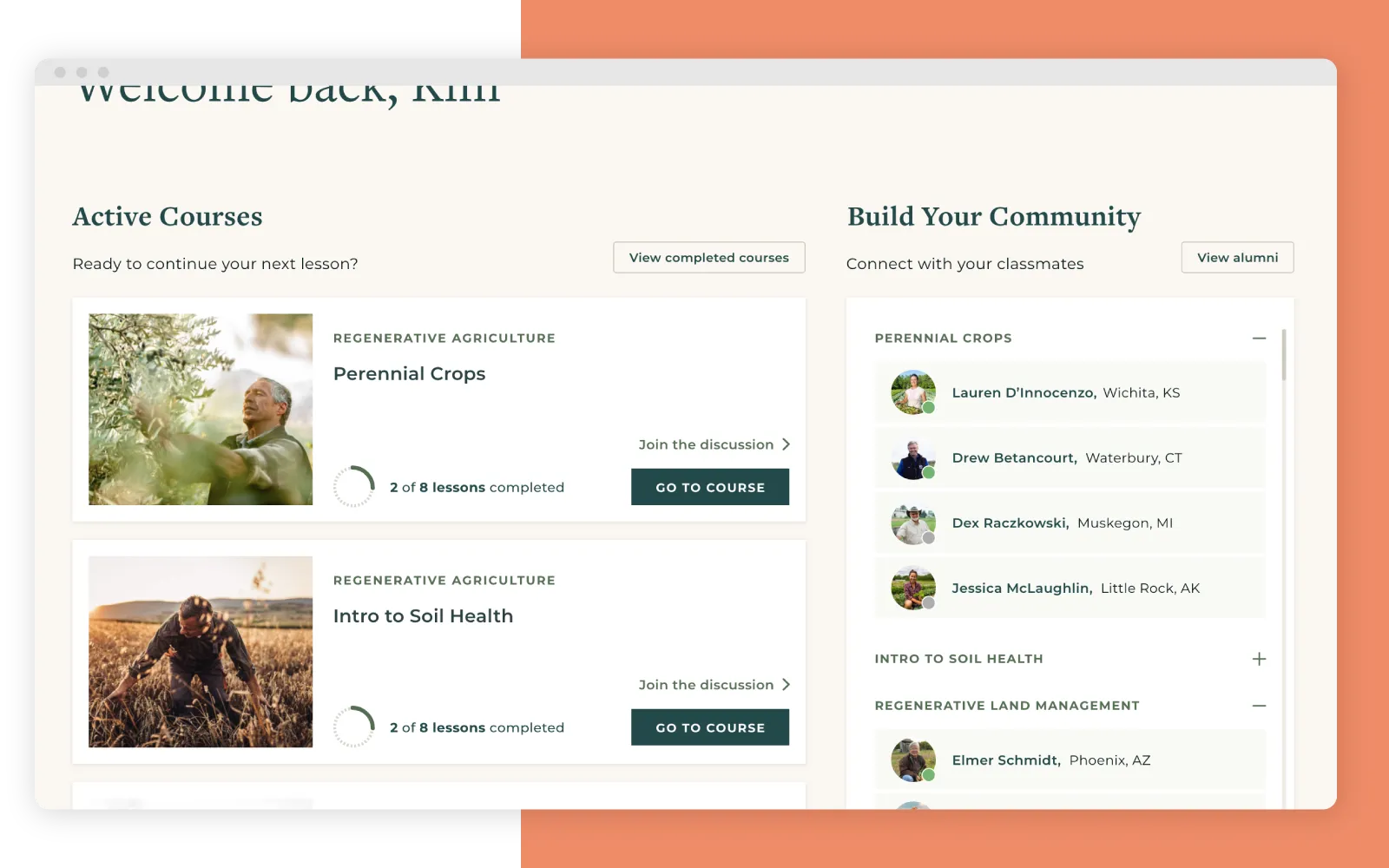
The design puts the whole community behind the learning rather than the teachers alone: lesson-attached forums where alumni answer alongside students, accountability partners backed by the research on what makes goals stick, and course videos built to be bookmarked, annotated and returned to from the field.
- Engagement | A platform built to keep a learner past the season the method costs them | Accountability partnerships, on research showing they lift follow-through from 65% to 95%
- Trust | Farmer stories making the argument a curriculum cannot | Lesson forums where the people who already converted answer the people deciding
The detail
Why teaching this is hard
- The short term argues against it. Regenerative farming is better for the environment and the economy over time. In the near term it is more work and more expensive than the chemical-heavy conventional approach it replaces, so the case has to survive a season in which the farmer is worse off.
- There is no single method to teach. The right techniques depend on geography, soil type and climate, which makes it a hard thing for someone to work out alone and a hard thing for a course to cover once.
- The stakes are not only the learner’s. At current rates of soil destruction scientists expect serious public health issues and food shortages within fifty years — the route that took Seraphic Group’s founder, Zach Bush, MD, from patterns in patient health to advocacy for regenerative agriculture.
- Education alone was not the brief. Atlus∗U had to teach the method, motivate a farmer to try it and keep them with it for the long haul. Any one of the three without the others produces a course no one finishes.
The call and the build
- The educational purpose set the feature set. A learning platform’s purpose determines which tools serve it. Atlus∗U spans two categories at once, Student Stakes Learning and Broad Stakes Learning, meaning the education matters both to the learner and to the community around them.
- Comprehension first, then motivation. The design vision concentrated on content comprehension and on keeping people engaged, because a farmer who understands the method and stops after one season has not been served.
- Content, accountability and community as one framework. Educational content and tools, accountability systems that keep someone moving, and community features that put learners in contact with each other.
- Farmers who had already done it. Personal stories from farmers who converted their own businesses successfully, which is the form of evidence that answers the objection a curriculum cannot.
What the design delivered
- The whole community drives the learning. Members-only forums for networking, questions, stories and support — some attached to specific lessons, so the dialogue is not only between teachers and students. Alumni participate too, which is how a course becomes a practice.
- An accountability partner system. The research the design leaned on: publicly sharing a goal gives a person a 65% chance of following through, and reporting to a specific accountability partner raises it to 95%. For a method whose first season is its hardest, that difference is the product.
- Videos built for reference, not just completion. Students bookmark course videos and attach notes to specific sections, so the material serves the fifth season as well as the first. A lesson you can return to in the field is worth more than a certificate.
- A living guide rather than a course. Seraphic wanted Atlus∗U to grow and change over time rather than ship as a fixed syllabus — where most platforms end at the certificate, here the end of the coursework is the start of the journey. The right shape for a practice whose correct application depends on where you farm and what your soil is.
Online learning platform questions
How do you design an online course people actually finish?
Treat retention as a design problem rather than a content problem. Atlus∗U pairs comprehension tools with motivation structures: progress tracking, community features that put learners in contact with each other, and personal stories from farmers who already converted — the form of evidence that answers the objection a curriculum cannot.
What keeps learners engaged after a course ends?
Community and accountability. Atlus∗U’s members-only forums attach to specific lessons and stay open to alumni, so the dialogue outlives the syllabus — and its accountability partner system leans on the research that publicly sharing a goal gives a 65% chance of follow-through while reporting to a specific partner raises it to 95%.
How should an online learning platform handle content people return to?
Build the material for reference, not just completion. Atlus∗U’s course videos can be bookmarked with notes attached to specific sections, so a farmer can revisit exactly the technique the season is testing — a living guide rather than a fixed syllabus, which is the right shape when the correct method depends on geography, soil and climate.
How do you design an online learning platform for behavior change?
For the Atlus∗U design by Pare & Co: a platform where the whole community drives the learning — lesson-attached forums with alumni in them, accountability partnerships built on the follow-through research, and reference-grade video tools — all aimed at the one metric that matters for regenerative farming: whether the farmer is still practicing it after the hard first season.